Media Home
 UN Web TV
 UN Audiovisual Library
 UN Photo
Security Council
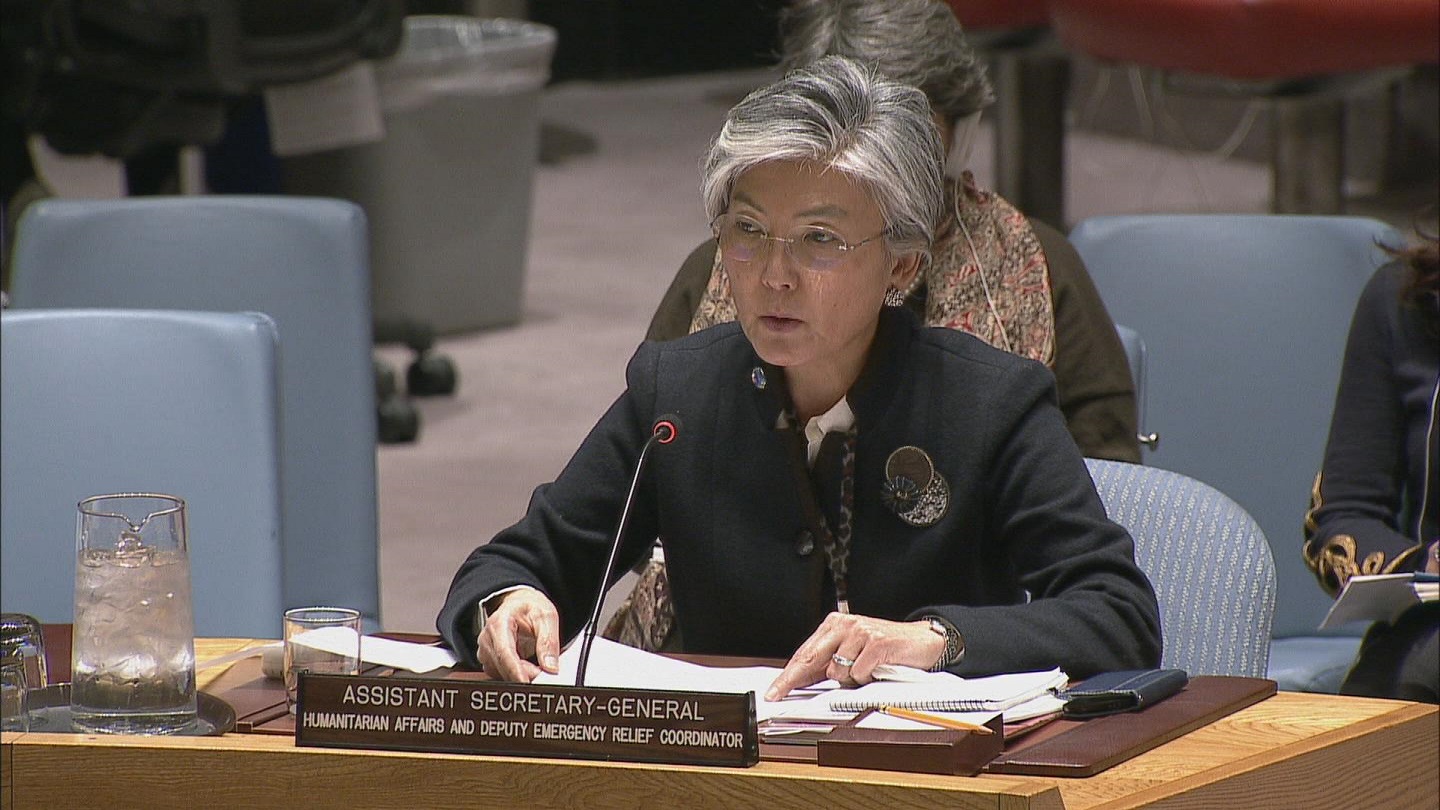
7605th Security Council Meeting: Situation in Middle East
Siege and starvation had become systematic in Syria, the Assistant Secretary-General for Humanitarian Affairs told the Security Council today during a meeting that heard calls for immediate, unhindered access for the delivery of humanitarian assistance to besieged and hard-to-reach areas of the country, as well as warnings that using starvation as a weapon amounted to a war crime.
Providing the Council with an update in a meeting called by France and the United Kingdom, Assistant Secretary-General Kyung-wha Kang, who is also the United Nations Deputy Emergency Relief Coordinator, described the “nightmarish” reality of civilian life, emphasizing that no rationale could justify the prevention of aid reaching those in need. The fault lay with the parties maintaining siege situations, which meant all sides, including the Government of Syria, which bore the primary responsibility for protecting its people.
Some 400,000 people were trapped in besieged areas, including towns and villages controlled by Islamic State of Iraq and the Levant (ISIL/Da’esh), Government or allied forces and non-State armed groups, she said. Some 4.5 million lived in hard-to-reach areas and were subjected to various restrictions, including the deliberate obstruction of aid delivery. In Madaya, the world had seen harrowing images of malnutrition and hunger.
Against that backdrop, she said, interagency convoys had reached Madaya and surrounding areas on 11 and 14 January, while four convoys had reached Kefraya with food, medicine and non-food items. The third part of the series of convoys had carried humanitarian assistance to 37,000 people in Homs governorate. “Food, water and medicine are not bargaining chips or favours that parties to conflict can grant or deny at will,” she stressed. They were the very essence of the right to survival, which the Council had a responsibility to protect. “You cannot let more people die under your watch,” she declared. The Council — and those supporting the warring parties — must place Syria on a firm path to peace, end the practice of siege and starvation and adhere to international humanitarian law.
During the ensuing debate, speakers described the Syrian crisis as the “worst tragedy of the century”, with many calling the use of famine as a weapon a war crime and renewing appeals for an immediate halt to attacks against civilians. While welcoming the arrival of aid into the besieged areas, several speakers said that such “ad hoc” deliveries were not enough, and called upon those with influence over the parties to help ensure that they allowed access.
Egypt’s representative condemned the targeting and exploitation of civilians as a tactic of war, saying that his country had established contacts with the United Nations, businessmen, opposition members and Government representatives inside Syria, in relation to attempts to reach those in besieged areas, regardless of their affiliation. Humanitarian efforts must rise above political differences, he emphasized.
Several speakers cautioned against politicizing the crisis, with the representative of the Russian Federation pointing out that two meetings on the Syrian situation in less than a week appeared to be an attempt to derail the 25 January launch of the intra-Syrian dialogue by those who did not like the Vienna agreements and could not abandon plans for a forceful solution to the crisis. There was no alternative intergovernmental cooperation, including through military presences, in combating terrorists, he said, adding that the Russian Federation’s proposals in that regard were on the table.
The representative of the United States said that assistance delivered to besieged towns this week was not nearly enough, and had arrived “far too late”. At least 32 people, including infants, had died in Madaya over the last 30 days, and the only two doctors in the town of 40,000 people had limited ability to treat the sick. She urged a re-examination of unsuccessful humanitarian strategies and called upon Member States to unite in exerting pressure on the Syrian Government — or any party over which they had influence — to allow humanitarian access.
Syria’s representative called for tackling the root cause of the conflict — terrorism — saying that the humanitarian disaster had arisen after terrorist groups had entered the country. The Government had deployed all its resources to help all those in need, without discrimination, having coordinated with the United Nations to provide assistance to millions of people. The idea that access to troubled areas could be achieved if the Government accepted all United Nations demands was simplistic, he said, emphasizing that some considerations, including the presence of terrorist groups, could not be ignored.
Also speaking today were representatives of France, United Kingdom, Spain, New Zealand, Senegal, China, Venezuela, Japan, Ukraine, Angola, Malaysia and Uruguay.
The meeting began at 3:08 p.m. and ended at 5 p.m.