Media Home
 UN Web TV
 UN Audiovisual Library
 UN Photo
Security Council
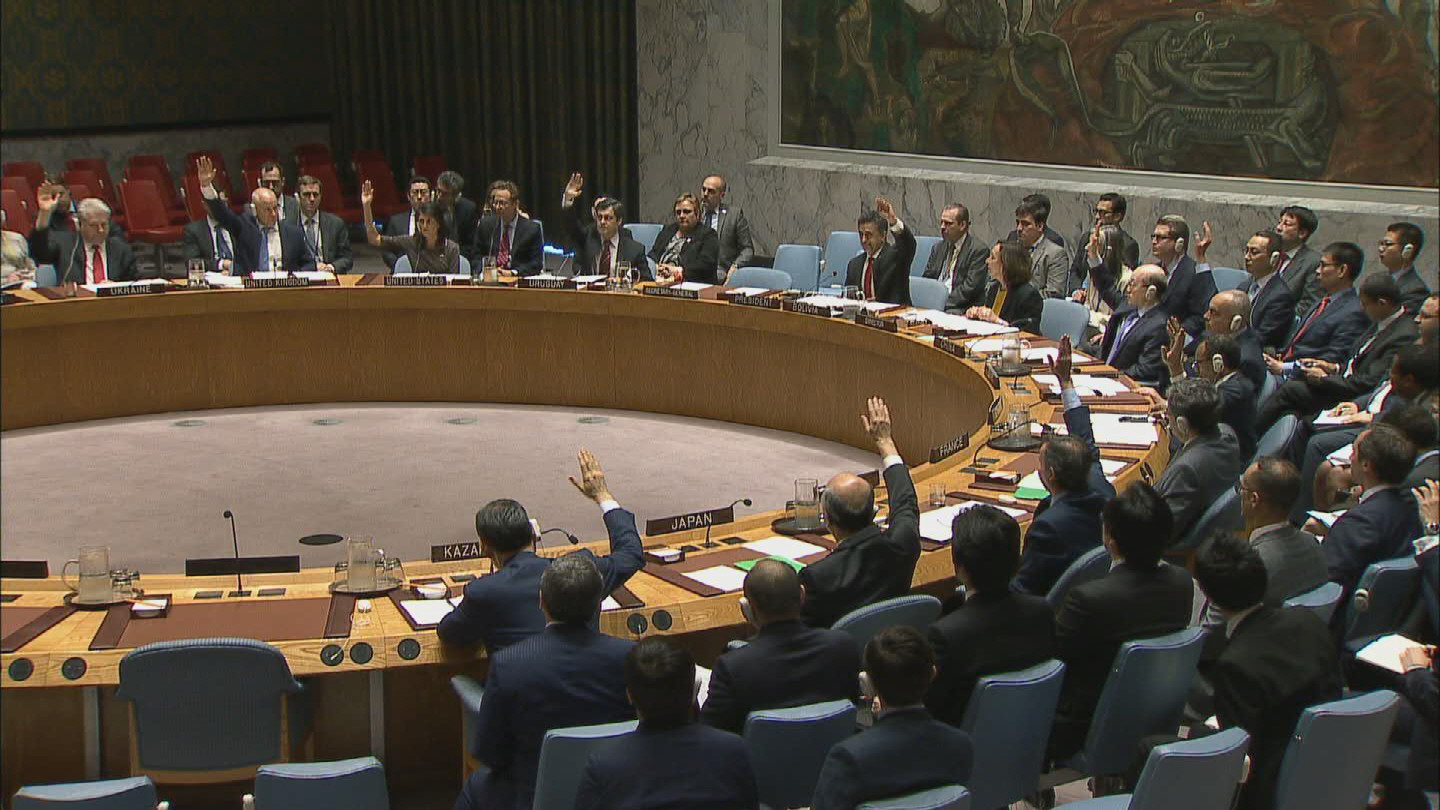
8072nd Security Council Meeting: Situation in Middle East - Part 1
Despite the overall negative trajectory that had characterized the Israeli‑Palestinian conflict for far too long, there were reasons for cautious optimism, the Assistant Secretary-General for Political Affairs told the Security Council today as the situation in the Middle East, including the Palestinian Question, was addressed in an all‑day debate that heard from more than forty speakers.
Miroslav Jenča said that the end to the more than 10‑year‑long Palestinian divide and Gaza’s return to the full control of the legitimate Palestinian Authority was an important development. On 12 October, with Egyptian mediation, Fatah and Hamas had signed an agreement by which the Palestinian Authority would take control of the Gaza crossings on 1 November and should assume its full responsibilities in Gaza by 1 December.
Drawing attention to the severity of the humanitarian crisis and continuing human rights abuses in the Gaza Strip, he reported that, for the sixth consecutive month, the enclave’s 2 million people had only received electricity for a mere four to six hours a day. The outages disrupted the health‑care, water supply and sanitation systems, he said, describing Gaza as an unfolding environmental disaster with no regard for borders.
The Israeli High Planning Committee was meeting on 17 and 18 October to advance plans for more than 2,000 housing units in Area C of the occupied West Bank, he continued. Reiterating the United Nations position that all settlement activities were illegal under international law and an impediment to peace, he said 2017 had seen a significant decrease in Area C demolitions. However, the number of demolitions in East Jerusalem was quickly approaching 2016 levels. Particularly disturbing were Israel’s reported plans to evict specific communities.
The current Palestinian efforts to return the Government to Gaza must be encouraged and supported, he said, also stressing that Palestinians must decide which path to take. As well, the international community must not only ensure that Palestinians were given every support and opportunity to reach a positive outcome, but it also must ensure that efforts could move forward to end the occupation, establish a viable, sovereign Palestinian State, living in peace and security beside Israel.
The Permanent Observer of the State of Palestine said the international community’s support for the recent developments were vital for ensuring success. However, there must also be efforts to lift the illegal and inhumane Israeli blockade and to expedite Gaza’s reconstruction. Calling for an end to all Israeli settlement activities and appealing to all States to adopt practical measures that would lead to a two‑State solution, he said that Israel’s contempt of international law and Council resolutions was the reason behind the lack of progress, as well as the negative trends that were destroying the two-State solution and the non‑revival of negotiations on final status issues. Asking “when will enough be enough?” he said it was high time for the Council to demand full respect and implementation of its resolutions, with Israel either compelled to comply or subjected to the same pressure and accountability that would be triggered by non‑compliance in other situations.
Israel’s representative also demanded action from the Council, calling on that organ to address the threat to international peace and security posed by Iran. Citing instances of that country’s sponsorship of terror, he pointed out that Hamas’ leader in Gaza had confirmed publicly that Iran was the largest backer, militarily and financially, of his organization. “Iran is waging war against Israel; Hamas, Hizbullah and Islamic Jihad are simply doing the dirty work”, he said, adding that Iran sought to wipe Israel off the map by any means necessary, including by developing nuclear weapons. The international nuclear agreement had not eliminated that last threat, as that country had continued to launch ballistic missiles capable of carrying nuclear warheads, a clear violation of Security Council resolution 2231 (2015). It was the responsibility of the Security Council to vigorously enforce the resolution and all others. “Or it can stand idly by as Iran’s reign of terror penetrates entire continents”, he said.
Echoing that stance, the United States’ delegate said that peace and security in the Middle East could not be addressed without discussing Iran. Her Government was now in the process of examining the question comprehensively alongside its monitoring of the nuclear weapons agreement. “Judging Iran by the narrow confines of the nuclear deal misses the threat”, she said. The launch of nuclear‑capable ballistic missiles had been ignored, along with an entire list of dangerous behaviour. The United States would not turn a blind eye; the Council now had an opportunity to reform its handling of the Iranian threat as well.
However, the United Kingdom’s representative said that, although United States President Donald Trump had decided not to recertify that Iran was compliant with the Joint Comprehensive Plan of Action, preserving that Plan was in the interest of all and a major step towards preventing diversion of Iran’s nuclear programme to the pursuit of weapons. He urged for careful consideration before taking any steps that might undermine the agreement, including the imposition of sanctions.
The Russian Federation’s delegate expressed surprise and dismay that speakers were addressing the nuclear agreement with Iran and not the Palestinian Question, as was announced in the agenda. Resolving the Palestinian situation was fundamental to normalizing the situation in the Middle East, he stressed, adding that a one‑State solution was not in the interest of the parties. There was no alternative to direct negotiations that established a Palestinian State living in peace side by side with Israel and he reiterated his country’s proposal to host direct negotiations between Israel and the State of Palestine.
France’s representative, Council President for October, emphasized that there was no alternative to the two‑State solution, which was severely threatened by the accelerated expansion of settlements. Condemning such activity, he announced that his Government was putting in place a differentiation policy, through which it would distinguish between its relationship with Israel and with settlement areas.
With over forty delegations weighing in, many speakers hailed the inter‑Palestinian reconciliation agreement between Hamas and Fatah, commending Egypt for its role in facilitating negotiations and expressing the hope that it would lead to an alleviation of the humanitarian situation in Gaza.
Speakers also underscored that the continuing land and naval blockade of Gaza, now in its eleventh year, was in violation of United Nations resolutions, and urged Israel to immediately open the border crossings to the strip to allow delivery of humanitarian aid. A unified Palestinian leadership was essential to the full reunification of the West Bank and Gaza and critical for a return to meaningful negotiations, numerous delegates said, expressing hope that the agreement would lead to legitimate elections.
Representatives also condemned Israeli settlement activities as a violation of international law, adding that such expansion would not engender an atmosphere conducive to peace. Calling for the parties to avoid creating situations on the ground that would impede progress to that end, many stressed that there was no alternative to the two‑State solution based on the pre‑1967 borders and with East Jerusalem as its capital, living in peace with Israel. Direct negotiation between parties was needed for that goal to be realized.
Also speaking today were representatives of Sweden, Senegal, Bolivia, Japan, Ukraine, Italy, Egypt, Ethiopia, Kazakhstan, China, Uruguay, Venezuela (for the Non‑Aligned Movement), Lebanon, Brazil, Iran, Indonesia, Peru, Pakistan, Syria, Kuwait, South Africa, Namibia, Bangladesh, Morocco, Qatar, United Arab Emirates, Nigeria, Jordan, Cuba, Maldives, Norway, Turkey, Bahrain, Saudi Arabia and Malaysia.
The Permanent Observer of the Holy See and the representative of the European Union delegation spoke as well, as did the representative of the Committee on the Exercise of the Inalienable Rights of the Palestinian People.
The representative of Israel took the floor for a second time.
The meeting began at 10:08 a.m. and ended at 3:30 p.m.