Media Home
 UN Web TV
 UN Audiovisual Library
 UN Photo
Security Council
8079th Security Council Meeting: Women and Peace and Security Part 3
Normative frameworks had been established and global awareness of the urgency of ending sexual atrocities and empowering women in conflict situations was growing, but progress on the ground must be accelerated, speakers told the Security Council in an all-day debate today.
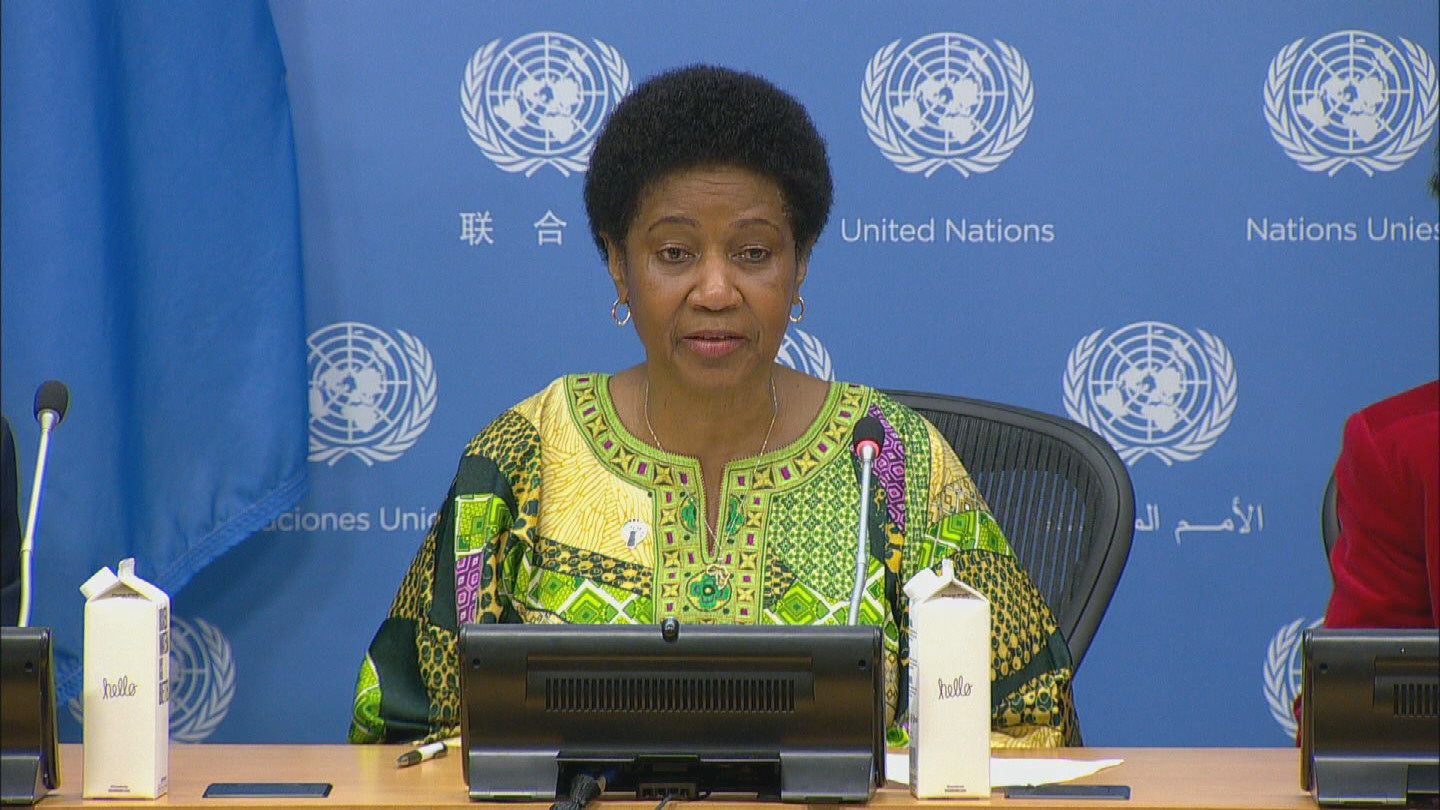
“The chorus of voices that are appalled by the persistent political marginalization of women in decision-making is speaking louder; the number of people who are determined to find new solutions to the human suffering caused by conflict is growing,” Phumzile Mlambo-Ngcuka, Executive Director of the United Nations Entity for Gender Equality and the Empowerment of Women (UN-Women), said in a briefing, ahead of over 85 speakers in the Council’s annual examination of progress and gaps in implementing resolution 1325 (2000) on women, peace and security. “But, that is just the beginning,” she declared, calling for redoubled efforts to empower and protect women throughout the United Nations system.
Maria Luiza Ribeiro Viotti, Chef de Cabinet of the Secretary-General; Michaëlle Jean, Secretary-General of the International Organisation of la Francophonie; and Charo Mina Rojas, a civil society representative from Colombia also briefed the Council.
Ms. Mlambo-Ngcuka said that the women, peace and security agenda was now an essential pillar of global affairs. However, all indicators showed a decline in women’s participation in peace processes around the world and in leadership positions in conflict zones, with some heartening exceptions, such as in the Colombia peace process. Similarly, awareness and documentation of sexual violence in conflict zones had soared, while actual prevention of such violence and prosecution of perpetrators sorely lagged. She urged greater funding for gender expertise and projects in conflict zones.
Ms. Viotti, introducing the Secretary-General’s latest report on the subject (document S/2017/861), affirmed that women’s underrepresentation in the security sector increased their exposure to harm and undermined their potential in conflict prevention. When the Council had visited the Lake Chad Basin, local leaders had emphasized the weak position of women as a root cause for the current crisis.
She described plans of the Secretary-General to achieve gender parity in the United Nations, noting that only 3 per cent of peacekeepers were women. Reform of the peace and security architecture would emphasize gender expertise, along with monitoring mechanisms targeting women marginalization. Council and other Member States would also be encouraged to share best practices.
Ms. Rojas described provisions of the Colombian peace agreement that she said had become a new source of hope for women’s empowerment, inclusiveness and conflict settlement. Ms. Jean, affirming a woefully low level of women’s participation in peacekeeping, described initiatives undertaken by la Francophonie to redress that situation and to ensure that women sat at negotiating tables in several African settings. She called for increased support to women’s grass-roots organizations and other instruments that could increase women’s participation.
Following those briefings, Member States’ representatives at the ministerial and diplomatic levels agreed that while normative frameworks to empower and protect women in conflict situations had made steady progress since the adoption of resolution 1325 (2000), real progress in women’s meaningful engagement in all phases of peacebuilding and their protection from abuse and exploitation were seriously lagging. Many speakers called for better ways to keep track of gender data to better monitor such progress.
Many countries described their national efforts to close the gap in their domestic policies, their international cooperation and their contributions to United Nations peacekeeping. The representative of the United Kingdom stressed the importance of sharing specific actions and best practices undertaken by countries, after 17 years of slow progress. In that vein, Senegal’s representative described regional efforts in West Africa, while Uruguay’s representative attested to the increased effectiveness of peacekeeping contingents deploying women.
The representative of the Democratic Republic of the Congo, noting that women in her country had been seriously affected by years of conflict, said that efforts to increase women’s participation in local levels of Government was paying out in the form of more effective peaceful conflict resolution in some provinces. Kazakhstan’s representative said that women, along with youth, must be seen as a critical link in the security/development nexus.
Ending violence against women, ensuring accountability for perpetrators and ensuring zero tolerance for sexual exploitation by peacekeepers were seen as urgent priorities by all speakers. In many situations, speakers said it was time to move past words and to action on the issue. In that vein, the representative of Bangladesh said rape and sexual abuse of Rohingya women was being used as a tactic of ethnic cleansing in Myanmar, and called for stronger action from the Council and the international community.
The Minister for Foreign Affairs of Sweden recounted her recent trip to Afghanistan, as well as her experience as the Secretary-General’s Special Representative on Sexual Violence in Conflict. She said it was a mistake to view such violence as inevitable or impossible to prosecute and ensure that impunity was ended. And to implement the full 1325 agenda, Member States must utilize the policy frameworks that have been put in place to actually empower women. “The frameworks and tools are in place,” she said. “It is up to us to make it happen.”
Also speaking today were the representatives of Ukraine, Bolivia, Italy, United States, Egypt, Ethiopia, Russian Federation, China, Japan, Kazakhstan, Uruguay, France, Colombia, Germany, Guatemala, Panama (on behalf of the Human Security Network), Liechtenstein, Tunisia, Turkey (also on behalf of Mexico, Indonesia, Republic of Korea and Australia), Nepal, Slovenia, Canada (on behalf of the Group of Friends of Women, Peace and Security), Iran, Czech Republic, Norway, Jordan, Brazil, Mexico, Namibia, Belgium, Indonesia, Spain, Slovakia, Peru, Argentina, Morocco, Switzerland, Qatar, Lithuania, Israel, South Africa, Ireland, Sri Lanka, Bangladesh, Albania, Hungary, Pakistan, Maldives, Netherlands, El Salvador, Chile, Jamaica, Iraq, Austria, Georgia, Botswana, India, Costa Rica, Romania, Philippines, Viet Nam, Kuwait, United Arab Emirates, Armenia, Trinidad and Tobago, Rwanda, Portugal, Thailand, Saudi Arabia, Afghanistan, Ecuador, Nigeria, Djibouti and Azerbaijan, as well as the Holy See, State of Palestine, European Union and the African Union.
Also speaking were representatives of the Organization for Security and Co‑operation in Europe (OSCE) and the North Atlantic Treaty Organization (NATO).
The meeting began at 10:19 a.m. and ended at 8:19 p.m.