Media Home
 UN Web TV
 UN Audiovisual Library
 UN Photo
Security Council
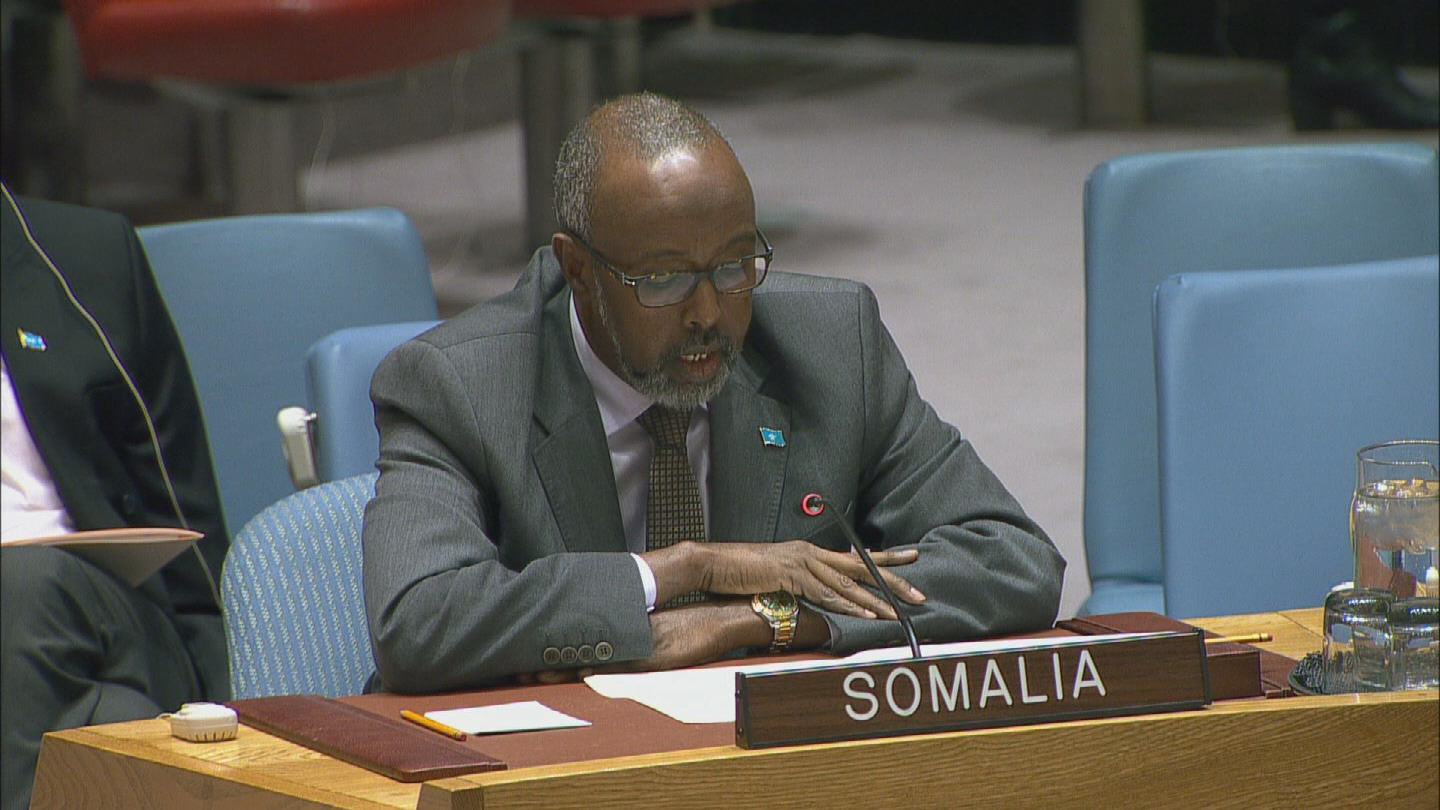
8398th Security Council Meeting: Situation in Somalia
Hailing the recent and historic rapprochements in the Horn of Africa, the Security Council today decided to lift the arms embargo, travel ban, assets freeze and targeted sanctions previously imposed on Eritrea, while simultaneously renewing its sanctions imposed against neighbouring Somalia.
Unanimously adopting resolution 2444 (2018) under Chapter VII of the Charter of the United Nations, the 15‑member Council terminated those measures imposed on Eritrea by its resolutions 1907 (2009), 2023 (2011), 2060 (2012) and 2111 (2013). It further decided to terminate the mandate of its Somalia and Eritrea Monitoring Group — effective 16 December — and to replace it with a Panel of Experts on Somalia tasked with overseeing the remaining sanctions on that country.
By the terms of the text, the Council welcomed a recent meeting between a representative of the Government of Eritrea and the Chair of the Committee pursuant to resolutions 751 (1992) and 1907 (2009) concerning Somalia and Eritrea, as well a meeting between a representative of the Government of Eritrea and the Coordinator of the Somalia and Eritrea Monitoring Group.
It also welcomed a September meeting between the Presidents of Djibouti and Eritrea; underlined the importance of continuing efforts towards the normalization of relations between the countries; and urged them to continue efforts to settle their border dispute peacefully in line with international law through conciliation, arbitration, judicial settlement or other pacific means laid out in Article 33 of the United Nations Charter.
Recalling that over the course of its current and four previous mandates the Monitoring Group had not found conclusive evidence that Eritrea supports the Al‑Shabaab terrorist group, the Council also expressed its satisfaction that funds derived from Eritrea’s mining sector are not contributing to violations of resolutions 1844 (2008), 1862 (2009), 1907 (2009) or 2023 (2011). In that regard, it decided that, from today’s date forward, States are no longer required to undertake the measures set out in paragraph 13 of resolution 2023 (2011) related to firms in their territory or jurisdiction that are active in Eritrea’s mining sector.
With regards to Somalia, the Council — renewing the arms embargo imposed by paragraph 5 of resolution 733 (1992), further elaborated upon in paragraphs 1 and 2 of resolution 1425 (2002) and modified in various subsequent resolutions —decided to renew the provisions set out in paragraph 2 of resolution 2142 (2014) until 15 November 2019. Those provided sanction exemptions for deliveries of weapons, ammunition or military equipment or the provision of advice, assistance or training intended solely for the development of the Security Forces of the Federal Government of Somalia to provide security for the Somali people.
The Council also decided that the newly established Panel of Experts on Somalia will continue the investigations started by the Somalia and Eritrea Monitoring Group related to the export to Somalia of various chemicals that may be used as oxidisers in the manufacture of improvised explosive devices. Condemning Al‑Shabaab’s increased revenue from natural resources and expressing concern about the group’s involvement in the illicit charcoal trade, it requested the Federal Government of Somalia to cooperate with the Panel of Experts to facilitate interviews of suspected members of Al‑Shabaab and Islamic State in Iraq and the Levant (ISIL/Da’esh) held in Government custody in order to assist the Panel with its investigations.
Expressing concern about continued reports of corruption and the diversion of public resources in Somalia, the Council also underlined that individuals engaged in acts that threaten the country’s peace and reconciliation process may be listed for targeted measures. It further reaffirmed its decision regarding the ban on the import and export of Somali charcoal — as set out in paragraph 22 of resolution 2036 (2012) — and urged Member States to continue their efforts to ensure its full implementation while reiterating that individuals and entities in violation may also be listed for targeted measures.
By other terms, the Council decided that until 15 November 2019 and without prejudice to humanitarian assistance programmes conducted elsewhere, the measures imposed by paragraph 3 of resolution 1844 (2008) — namely, an assets freeze — will not apply to the payment of funds, other financial assets or economic resources necessary to ensure the timely delivery of urgently needed humanitarian assistance in Somalia. It also decided to expand the targeted sanctions on Somalia to include the planning, directing or commission of acts involving sexual and gender‑based violence.
Following the adoption, Council members took the floor to hail a “new era of peaceful cooperation” in the Horn of Africa. Some speakers, welcoming the rapprochement between Eritrea and Djibouti, expressed hope that while the world remains a chaotic place, some “winds of hope are blowing”. Several delegates emphasized that the lifting of sanctions does not relieve the Security Council from its responsibility to closely monitor the situation, citing remaining security challenges, a not‑yet‑resolved border dispute between Eritrea and Djibouti and the overall fragility of the peace between those two countries. Others underlined the importance of maintaining pressure on any spoilers in Somalia — including through the newly reconstituted Panel of Experts — and strongly condemned deadly the Al‑Shabaab bomb attacks that killed more than 50 civilians in Mogadishu last week.
Karen Pierce (United Kingdom), whose delegation sponsored today’s resolution, said the text recognizes recent positive developments in the Horn of Africa while committing the Council to support the ongoing normalization of relations between the subregion’s nations. Among other things, she stressed that the text sends an important message that if the right progress is made sanctions can be lifted by the Council in good time.
Taye Atske Selassie Amde (Ethiopia), welcoming the adoption of the balanced and properly negotiated text, said his subregion’s trajectory has changed dramatically in recent years. Citing major historic developments, including the recent rapprochement between Eritrea and Djibouti, he stressed that the easing of tensions is “changing the landscape of the Horn of Africa and beyond”. It is critical for the Security Council to take such important decisions when countries are turning a new page, he said, adding that its decision today will help countries usher in a new era of friendship.
Vassily A. Nebenzia (Russian Federation), joining others in welcoming the resolution’s adoption, underscored that his delegation has long favoured the lifting of outdated sanctions imposed against Eritrea. He also voiced concern about the decision to add the crimes of sexual and gender‑based violence to the listing criteria for targeted sanctions against individuals and entities in Somalia, warning that it will result in reducing those measures’ effectiveness. “This particular issue is not our remit,” he stressed, noting that the Human Rights Council and the Commission on the Status of Women, among others, are the proper forums to address such matters.
“The long overdue call for justice is finally answered,” said Amanuel Giorgio (Eritrea), emphasizing that the lifting of sanctions marks an end to a difficult period for his country and the region. Voicing regret over sanctions’ harmful consequences across the entire Horn of Africa, he commended his people for enduring that hardship, adding that they will now work to build a peaceful, prosperous and confident country. Thanking Ethiopia and Somalia for their courageous position in calling for the immediate lifting of sanctions, he also welcomed the Council’s support for efforts to usher in a new era. “The region now needs understanding and the policy space to chart its own future, based on shared history, culture and interest of the people of the region,” he said.
Mohamed Siad Doualeh (Djibouti), welcoming the lifting of sanctions on Eritrea, as well as the Council’s concern over his country’s security, expressed support for calls to accelerate the regional roadmap and extend the mandate of the African Union Mission in Somalia (AMISOM). However, Al‑Shabab remains a danger that must be faced and all unresolved differences on boundaries and other issues must not be allowed to linger. His Government remains committed to deepening dialogue with Eritrea for those purposes and to ensure the release of 13 remaining prisoners of war. Among other things, he urged Council members to ensure that the current momentum be maintained in order to transform the region for the better.
Abukar Dahir Osman (Somalia) congratulated Eritrea for withstanding the hardship of decades of sanctions and hailed the normalization of relations in the subregion. Reiterating his request that sanctions against his own country be lifted, he said those flawed and outdated measures violate Somalia’s sovereignty and prevent it from building an effective national army. Al‑Shabaab continues to strike within Somalia and while nations around the globe offer their condolences, they fail to recognize that their sanctions do not effectively target that dangerous terrorist group. Al‑Shabaab continues to receive weapons and support from abroad and the impact of the war in Yemen — just across the Gulf of Aden — is particular acute, as Somalia remains unable to properly protect its coastline. “What is the purpose of the sanctions if violations by Member States are not addressed by the Council?” he asked.
Also speaking were representatives of Sweden, Kazakhstan, United States, France, Poland, Netherlands, Equatorial Guinea, Bolivia, Peru, Kuwait and China.
The meeting began at 10:05 a.m. and ended at 11:10 a.m.
For further details please see:
MEETINGS COVERAGE