Media Home
 UN Web TV
 UN Audiovisual Library
 UN Photo
UN / DIAMONDS AND CONFLICT
STORY: UN / DIAMONDS AND CONFLICT
TRT: 02:30
SOURCE: UNIFEED
RESTRICTIONS: NONE
LANGUAGES: ENGLISH / NATS
DATELINE: 03 APRIL 2024, NEW YORK CITY / FILE
FILE - NEW YORK CITY
1. Wide shot, exterior United Nations Headquarters
03 APRIL 2024, NEW YORK CITY
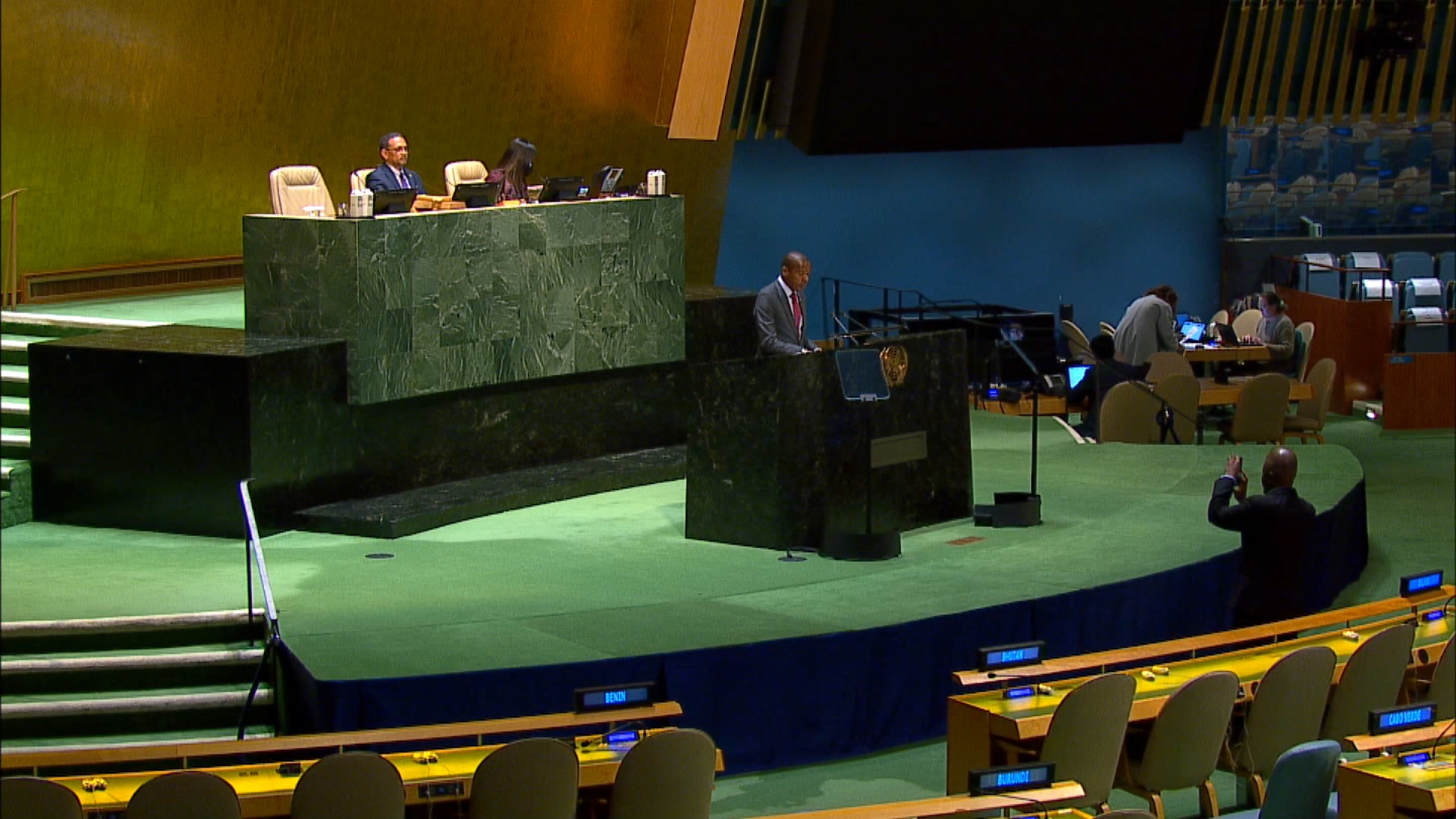
2. Wide shot, General Assembly
3. Wide shot, EU representative walks up to the GA rostrum
4. SOUNDBITE (English) Clayton Curran, Policy Advisor, European Union Delegation to the United Nations:
“For the first time in its history, the plenary has failed to produce a consensus communique. With a mandate deeply rooted in the full respect for state sovereignty, this resolution reminds us of the obligations placed upon states by the charter of the United Nations regarding the maintenance of international peace and security, and that state sovereignty should be fully respected. Therefore, we cannot but condemn the aggression of one Kimberley Process participant against another. It is why we must continue to work on the reform of the Kimberley Process. We need to seize the opportunity of the review and reform cycle, to broaden the definition of conflict diamonds, to capture the evolving nature of conflicts and the realities on the ground.”
5. Wide shot, Russian Federation representative Alexander Repkin walks up to the GA rostrum
6. SOUNDBITE (English) Alexander Repkin, Deputy Director of the Department of Economic Cooperation of the Ministry of Foreign Affairs, Russian Federation:
“Unfortunately, driven by the notion of their own exceptionalism, representatives of Western countries decided to sabotage a whole host of international cooperation on the global diamond sector to serve their own geopolitical interests. This is the third year in a row that the Kimberley Process has found itself under unprecedented pressure from a narrow group of countries unable to turn the process into yet another instrument to exert pressure on sovereign states. The Western States choose to sabotage its work and compromise the achievements of it with a view to subsequently replacing the Kimberley Process with a unilateral discriminatory mechanism of the Group of Seven.”
7. Wide shot, Tanzanian Ambassador Hussein Athuman Kattanga walks up to the GA rostrum
8. SOUNDBITE (English) Hussein Athuman Kattanga, Permanent Representative to the United Nations, Tanzania:
“The reason why we support this draft resolution is the fact that it aims to address the insecurity fuelled by conflict diamonds. We are convinced that the relevant resolution is a necessary measure on the promoting states sovereignty, poverty eradication, conflict prevention and elimination of conflict demand from legitimate trade, which are the primary objective of the Kimberley Process.”
9. Wide shot, Kattanga walks away
10. UPSOUND (English) Lamin B. Dibba, Permanent Representative to the United Nations, Gambia:
“May I take it that the Assembly wishes to adopt Travelodge resolution A/78/L.54. It's so decided.”
11. Wide shot, General Assembly
The General Assembly today (3 Apr) adopted a resolution on the role of diamonds in fuelling conflict, expressing deep concern regarding the unprecedented challenges faced by the Kimberley Process arising from ongoing geopolitical tensions and conflicts.
The resolution notes “with regret” that the 2023 Kimberley Process plenary meeting ended without consensus on a communiqué.
Speaking before the vote, the Policy Advisor of the European Union Delegation to the United Nations, Clayton Curran said, “for the first time in its history, the plenary has failed to produce a consensus communique.”
Curran expressed support for the draft resolution and said, “we cannot but condemn the aggression of one Kimberley Process participant against another. It is why we must continue to work on the reform of the Kimberley Process. We need to seize the opportunity of the review and reform cycle, to broaden the definition of conflict diamonds, to capture the evolving nature of conflicts and the realities on the ground.”
The Russian Federation representative Alexander Repkin told the General Assembly that “unfortunately, driven by the notion of their own exceptionalism, representatives of Western countries decided to sabotage a whole host of international cooperation on the global diamond sector to serve their own geopolitical interests.”
Repkin said this was “the third year in a row that the Kimberley Process has found itself under unprecedented pressure from a narrow group of countries unable to turn the process into yet another instrument to exert pressure on sovereign states.”
The Western States, he said, “choose to sabotage its work and compromise the achievements of it with a view to subsequently replacing the Kimberley Process with a unilateral discriminatory mechanism of the Group of Seven.”
The Russian Federation currently produces almost a third (31 per cent) of the world's diamonds.
Tanzanian Ambassador Hussein Athuman Kattanga for his part said, “the reason why we support this draft resolution is the fact that it aims to address the insecurity fuelled by conflict diamonds. We are convinced that the relevant resolution is a necessary measure on the promoting states sovereignty, poverty eradication, conflict prevention and elimination of conflict demand from legitimate trade, which are the primary objective of the Kimberley Process.”
The Kimberley Process (KP) is a commitment to remove conflict diamonds from the global supply chain. It defines conflict diamonds as: ‘rough diamonds used to finance wars against governments’ - around the world.
82 governments have enshrined the Kimberley Process Certification Scheme (KPCS) into law. Today, 99,8 percent of the world’s diamonds come from conflict-free sources.
The Kimberley Process Certification Scheme (KPCS) is a joint-government, internationally recognized certification system that imposes extensive requirements on its members to enable them to certify shipments of rough diamonds as ‘conflict-free’ and prevent conflict diamonds from entering legitimate trade.
Before the KPCS came into existence, conflict diamonds accounted for as much as 15 percent of the global diamond market.