Media Home
 UN Web TV
 UN Audiovisual Library
 UN Photo
OHCHR / TURK PRESSER
STORY: OHCHR / TURK PRESSER
TRT: 08:53
SOURCE: OHCHR
RESTRICTIONS: NONE
LANGUAGE: ENGLISH / NATS
DATELINE: 11 JUNE 2025 GENEVA, SWITZERLAND
1. Various shots, exterior, Palais Wilson UN Human Rights HQ
2. Journalist: “I'm just wondering. It seems that in some places, like in Los Angeles, people are being taken off the street. And families do not know where they are. I'm just wondering how you see that in terms of international law. I'm thinking about the convention on enforced disappearances, for example?
3. SOUNDBITE (English) Volker Türk, UN High Commissioner for Human Rights:
“Well it’s absolutely clear and I have been on public record about the concerns that we have about regarding the process of deportations. It requires due process for example. It requires proper procedures that ensure the dignity of each and every person. And it requires respect for international human rights law and international refugee law. For example, if there are people who say they may be tortured and people saying that they cannot be returned. They cannot be deported. So yes, what we need is international human rights law and international refugee law fully respected.”
4. Journalist: "Do you think that is being respected?"
5. SOUNDBITE (English) Volker Türk, UN High Commissioner for Human Rights:
“We have serious concerns about the process.”
6. Journalist: Question on the humanitarian situation in Gaza.
7. SOUNDBITE (English) Volker Türk, UN High Commissioner for Human Rights:
“It is absolutely clear that the humanitarian situation in Gaza is beyond any description that you could possibly imagine. It is precarious, and I don't even know which words to use. Because as you know most of the population has not had humanitarian assistance for many, many weeks. It's already an extremely dire situation with emaciated children, with people who have no access to medicine anymore, with no food items for weeks that couldn't get in. The UN has been very clear: we have a plan, we have been able to work there before. Unfortunately, we have been extremely constrained in the way that we're doing. Now we have this new mechanism -- it doesn’t fulfill the basic principles of humanitarian action, which means impartiality, neutrality and independence. And as a result, we could not be part of it. The situation is horrific. Anyone who wants to put emphasis on this situation, that's very important, because we need to bring attention to it so that everyone wakes up and does something about it.”
8. Journalist: “Regarding the rumors about relocation. Can you tell us more about it? Is it true that the office is going to move to Austria?”
9. SOUNDBITE (English) Volker Türk, UN High Commissioner for Human Rights:
“So, first of all, my Office faces a very dire financial situation. We unfortunately are not going to be able to come to the same funding level as last year. We are probably falling short of about $60 million. Which means that our important work in a number of country situations cannot be done. Part of my reform efforts has been to look at how we can strengthen regional and country office. So this has been a process that has been going on for a while. We have looked at six different regional offices: Beirut, Yaoundé, Cameroon, Bangkok, Panama and Addis [Ababa], as well as Vienna. Vienna is one of the possible areas where we want to strengthen our regional presence. And, it is part of a reform effort that is ongoing -- because we want to be closer to the people we serve.”
10. Journalist: “You want to see better leadership from the European Union, on all matters that concern your Office and the pressures on human rights. What is your message? What do you want to hear from the EU?”
11. SOUNDBITE (English) Volker Türk, UN High Commissioner for Human Rights:
“So, human rights is more important than ever in the last 80 years, because what we need at a time that is foggy, that is uncertain and that is turbulent, we need everyone to remember where the human rights framework came from. That it is our principles, it is our values, it is our norms. They are tested and tried over many decades and investment in human rights is more important than ever before because it gets people out of detention, it changes laws. It is a factor of stability. So, I hope that the political leadership around the world and including in Europe wakes up to that reality. And my call on them is to support the Human rights cause strategically, politically, but also financially. “
12. Journalist: On the attack in Colombia, what is your concern about the future of the peace agreement in Colombia?
13. SOUNDBITE (English) Volker Türk, UN High Commissioner for Human Rights:
“Well, it is absolutely clear that in pre-electoral periods it is important to ensure that violence is not part of the equation. I would separate this from the peace process because this process is an ongoing thing. We have seen progress. We have also seen the killings of human rights defenders -- and that's something that we have taken up with the authorities on numerous occasions. It's really important that ahead, in this pre -electoral period, that indeed civic space is respected fully, that people are able to express themselves and that violence is not part of the equation. It's a horrendous attack [on Miguel Uribe Turbay].”
14. Journalist: Going back to the protests in LA. Are your concerned that human rights are being violated in the crackdown on protesters in the United States? What can you say very bluntly what your concerns are?
15. SOUNDBITE (English) Volker Türk, UN High Commissioner for Human Rights:
“So, first of all, there is the right to freedom of peaceful assembly, and it needs to be guaranteed. And it is also important, when you look at the dispersal of protesters, for example, that this adheres to international human rights norms and standards, meaning principles of legality, of precaution, of necessity, [they] need to be respected.”
16. Journalist: I don’t think a lot of people on the street are going to see what that means. Could you translate in a way someone on the street would understand.
17. SOUNDBITE (English) Volker Türk, UN High Commissioner for Human Rights:
“Human rights are part and parcel of any attempt by law enforcement to deal with a peaceful protest, and peaceful protests are a fundamental human right.”
18. Journalist: Asks about funding shortfall and does this mean cutting programs on the ground?
19. SOUNDBITE (English) Volker Türk, UN High Commissioner for Human Rights:
“Yes, for example, I will not be able to staff 11 countries with a human rights presence, meaning that we are not able to analyze the laws. We're not able to build a bridge between civil society and the institutions of the State. We may not be able to get people out of detention. We may not be able to monitor trials. We will not be able to do the essential work of influencing policies and goals and ensuring that we respect human rights. Yes, it will mean that people would suffer as a result of this.”
20. Various shots, press at briefing in Palais Wilson
Asked about the recent protests in Los Angeles, UN High Commissioner for Human Rights Volker Türk said said, “Human rights are part and parcel of any attempt by law enforcement to deal with a peaceful protest, and peaceful protests are a fundamental human right.”
Türk also said, “regarding the process of deportations, it requires due process” and “proper procedures that ensure the dignity of each and every person. And it requires respect for international human rights law and international refugee law.”
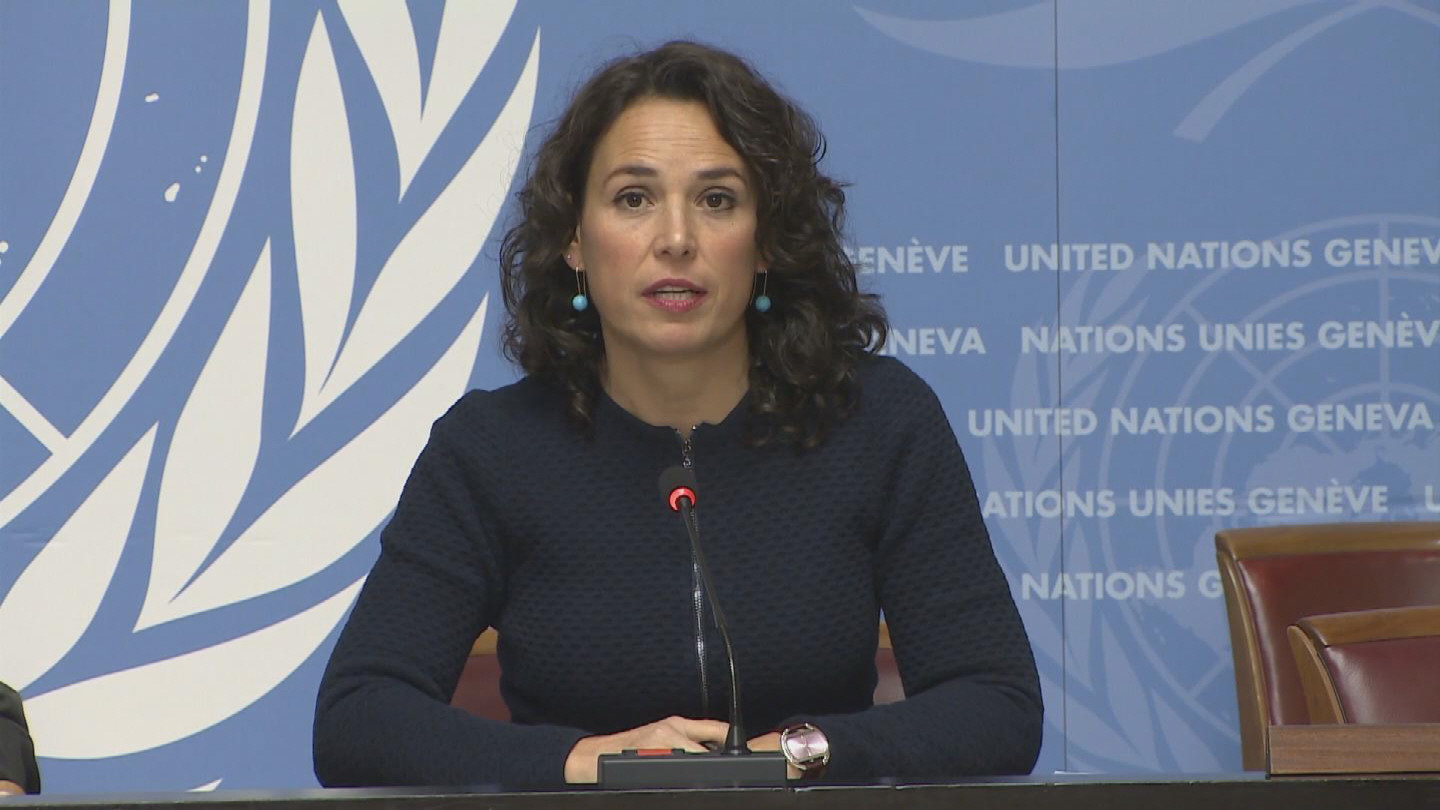
The UN human rights chief today (11 Jun) spoke to reporters in Geneva.
Asked about the humanitarian situation in Gaza, Türk said, “It is absolutely clear that the humanitarian situation in Gaza is beyond any description that you could possibly imagine. It is precarious, and I don't even know which words to use.”
He continued, “as you know most of the population has not had humanitarian assistance for many, many weeks. It's already an extremely dire situation with emaciated children, with people who have no access to medicine anymore, with no food items for weeks that couldn't get in.”
“The UN has been very clear: we have a plan, we have been able to work there before. Unfortunately, we have been extremely constrained in the way that we're doing. Now we have this new mechanism -- it doesn’t fulfill the basic principles of humanitarian action, which means impartiality, neutrality and independence. And as a result, we could not be part of it,” the human rights chief stressed.
He added, “The situation is horrific. Anyone who wants to put emphasis on this situation, that's very important, because we need to bring attention to it so that everyone wakes up and does something about it.”
The High Commissioner also told reporters that is Office faces a “very dire” financial situation.
“We unfortunately are not going to be able to come to the same funding level as last year. We are probably falling short of about $60 million. Which means that our important work in a number of country situations cannot be done.,” he explained.
Türk added, “Part of my reform efforts has been to look at how we can strengthen regional and country office. So this has been a process that has been going on for a while. We have looked at six different regional offices: Beirut, Yaoundé, Cameroon, Bangkok, Panama and Addis [Ababa], as well as Vienna. Vienna is one of the possible areas where we want to strengthen our regional presence. And, it is part of a reform effort that is ongoing -- because we want to be closer to the people we serve.”
Asked about the European Union, the High Commissioner said, “human rights is more important than ever in the last 80 years, because what we need at a time that is foggy, that is uncertain and that is turbulent, we need everyone to remember where the human rights framework came from. That it is our principles, it is our values, it is our norms. They are tested and tried over many decades and investment in human rights is more important than ever before because it gets people out of detention, it changes laws. It is a factor of stability.”
“I hope that the political leadership around the world and including in Europe wakes up to that reality. And my call on them is to support the Human rights cause strategically, politically, but also financially,” he added.
Asked about the situation in Colombia and the peace process, the High Commissioner said, “it is absolutely clear that in pre-electoral periods it is important to ensure that violence is not part of the equation.”
“I would separate this from the peace process because this process is an ongoing thing,” he stressed, adding that “we have seen progress. We have also seen the killings of human rights defenders -- and that's something that we have taken up with the authorities on numerous occasions. It's really important that ahead, in this pre -electoral period, that indeed civic space is respected fully, that people are able to express themselves and that violence is not part of the equation. It's a horrendous attack [on Miguel Uribe Turbay].”
Download
There is no media available to download.