Media Home
 UN Web TV
 UN Audiovisual Library
 UN Photo
UN / PREVENTING VIOLENT EXTREMISM
STORY: UN / PREVENTING VIOLENT EXTREMISM
TRT: 2:33
SOURCE: UNIFEED
RESTRICTIONS: NONE
LANGUAGE: ENGLISH / NATS
DATELINE: 12 FEBRUARY 2026, NEW YORK CITY / FILE
FILE – NEW YORK CITY
1. Wide shot, exterior, United Nations Headquarters
12 FEBRUARY 2026, NEW YORK CITY
2. Wide shot, press briefing room
3. SOUNDBITE (English) Alexandre Zouev, Acting Under-Secretary-General for Counterterrorism, United Nations:
“This technology holds real promise for prevention, from early detection of harmful narratives to more targeted, community informed interventions. But they're also being misused to amplify myths and disinformation, spread violent extremism content, and enable recruitment and radicalization to terrorism, especially of young people and teenagers.”
4. Wide shot, press briefing room
5. SOUNDBITE (English) Alexandre Zouev, Acting Under-Secretary-General for Counterterrorism, United Nations:
“Our message today is, therefore, that we must seize the opportunities of new and emerging technologies, but we must also manage the risks with transparency and accountability in full respect for human rights indeed.”
6. Wide shot, press briefing room
7. SOUNDBITE (English) Alexandre Zouev, Acting Under-Secretary-General for Counterterrorism, United Nations:
“We are expanding our practical support to help Member States navigate emerging risks in digital spaces. And that includes new workstreams on artificial intelligence and online gaming systems while reinforcing evidence based, human rights based prevention approaches. This complements ongoing capacity building efforts to strengthen strategic communications, empower young people and develop PCVE (Preventing and Countering Violent Extremism) policies ensuring coherence between traditional prevention approaches and technology driven initiative.”
8. Wide shot, press briefing room
9. SOUNDBITE (English) Alexandre Zouev, Acting Under-Secretary-General for Counterterrorism, United Nations:
“There are former terrorist fighters and they also should be investigated. We cannot label everybody who is in Camp Al Hol, or any other similar camps, because it should be investigated. And if they committed some crimes, they should be prosecuted according to national or international standards of prosecution and law.”
10. Wide shot, press briefing room
11. SOUNDBITE (English) Alexandre Zouev, Acting Under-Secretary-General for Counterterrorism, United Nations:
“There are many women, mostly former wives or real wives right now with many children and coming from different countries. And I know that say in Central Asia, the governments of Kazakhstan and Uzbekistan are making a great effort to reintegrate and socially rehabilitate families of former fighters because they had also certain citizens of these countries recruited.”
12. Wide shot, press briefing room
UN senior official for counterterrorism Alexandre Zouev said while seizing the opportunities of new and emerging technologies to prevent violent extremism, the risks with transparency and accountability in full respect for human rights must be managed.
Today (12 Feb), the United Nations marked the fourth observance of the International Day for the Prevention of Violent Extremism as and when Conducive to Terrorism, under the theme “Preventing Violent Extremism in the Age of New and Emerging Technologies”.
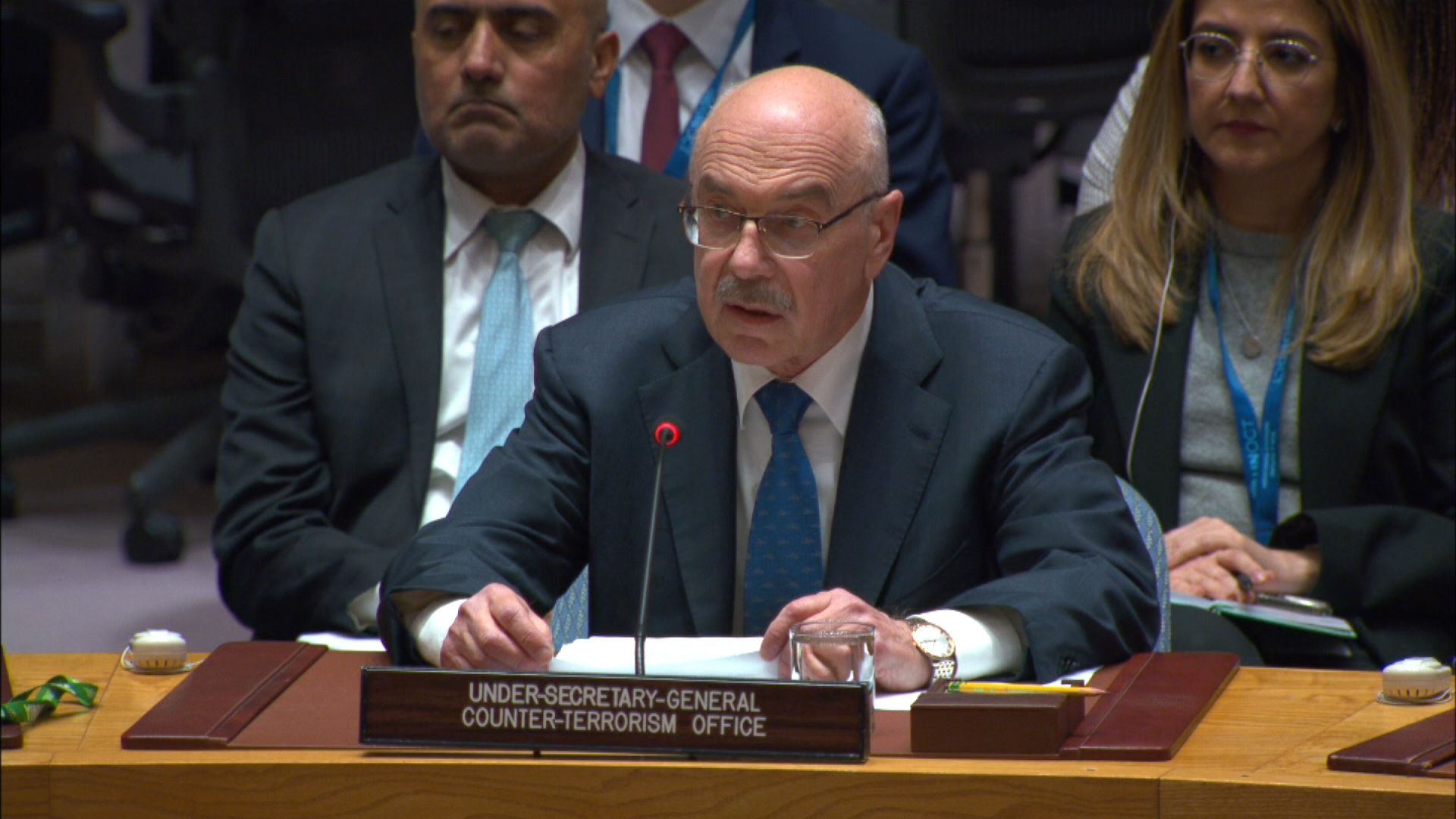
Acting Under-Secretary-General for Counterterrorism Alexandre Zouev briefed reporters in New York.
On artificial intelligence, Zouev said, “this technology holds real promise for prevention, from early detection of harmful narratives to more targeted, community informed interventions. But they're also being misused to amplify myths and disinformation, spread violent extremism content, and enable recruitment and radicalization to terrorism, especially of young people and teenagers.”
The UN top counterterrorism official also said, “We are expanding our practical support to help Member States navigate emerging risks in digital spaces. And that includes new workstreams on artificial intelligence and online gaming systems while reinforcing evidence-based, human rights-based prevention approaches.”
He added, “this complements ongoing capacity building efforts to strengthen strategic communications, empower young people and develop PCVE (Preventing and Countering Violent Extremism) policies ensuring coherence between traditional prevention approaches and technology driven initiative.”
Asked about repatriation and reintegration of former fighters, Zouev said that they should be investigated, adding “if they committed some crimes, they should be prosecuted according to national or international standards of prosecution and law.”
He pointed out that there is also the aspect of women with children, who are the former or current wives of the former fighters. He took Central Asia, the governments of Kazakhstan and Uzbekistan as example, who are “making a great effort to reintegrate and socially rehabilitate families of former fighters because they had also certain citizens of these countries recruited.”
Established by the United Nations General Assembly in its resolution 77/243, the International Day provides a platform for Member States, the United Nations system and all relevant stakeholders - including civil society, religious leaders, the private sector, academia and the media, to come together to strengthen the international community’s resolve to address the conditions conducive to terrorism, to raise awareness on the threat of violent extremism, and to renew collective action to prevent its spread.
The observance aims to promote inclusive, human rights-based and gender-responsive approaches to prevention, grounded in dialogue, partnerships and community-led solutions.
Download
There is no media available to download.
Related Content
Fourth United Nations High-Level Conference on Counter-Terrorism…
UN / COUNTER TERRORISM ISIL DAESH
Threats to international peace and security caused by terrorist…