Media Home
 UN Web TV
 UN Audiovisual Library
 UN Photo
UN / WEST AFRICA THE SAHEL
STORY: UN / WEST AFRICA THE SAHEL
TRT: 4:32
SOURCE: UNIFEED
RESTRICTIONS: NONE
LANGUAGE: ENGLISH / FRENCH / NATS
DATELINE: 14 JULY 2026, NEW YORK CITY / FILE
FILE – NEW YORK CITY
1. Wide shot, exterior, United Nations Headquarters
14 JULY 2026, NEW YORK CITY
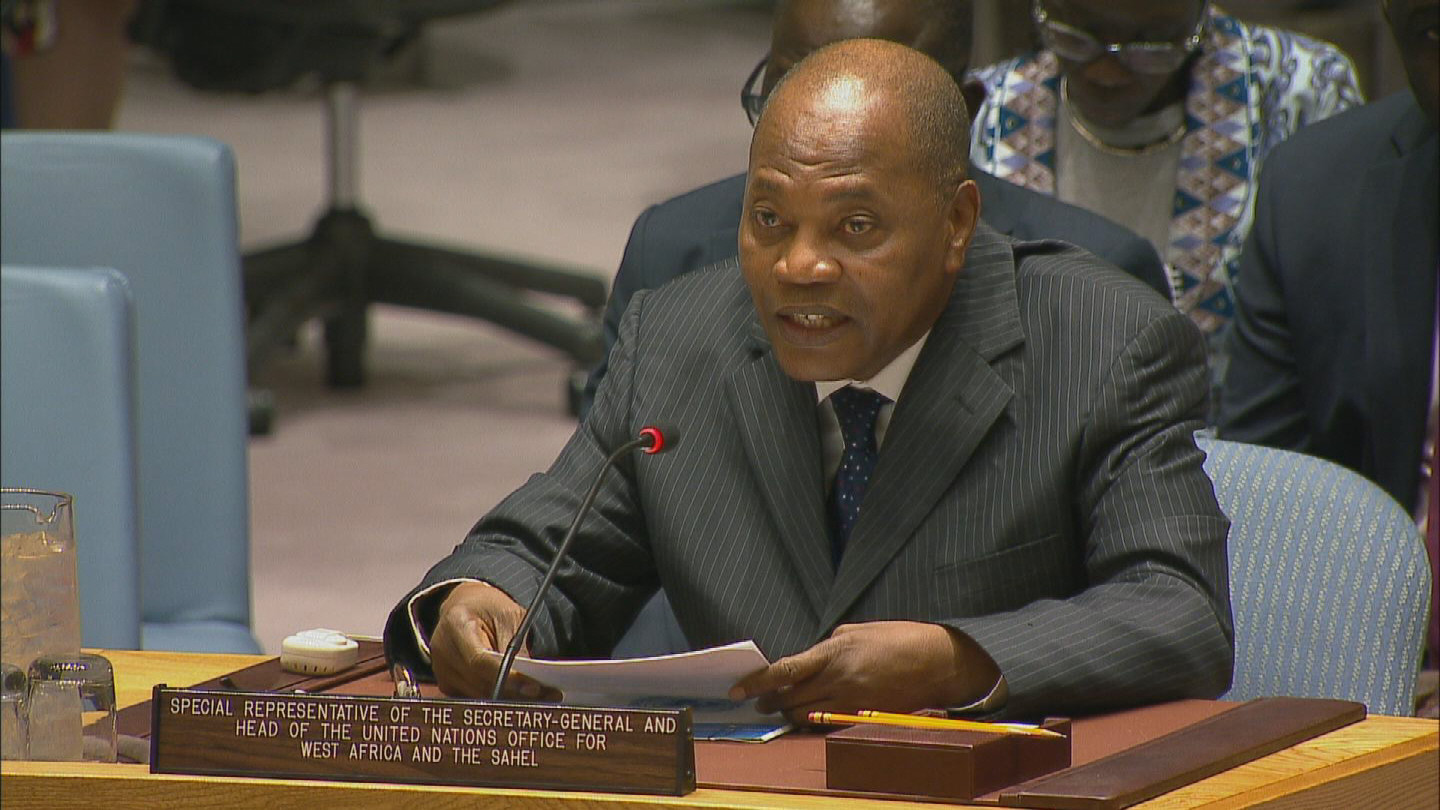
2. Wide shot, Security Council
3. SOUNDBITE (English) Leonardo Santos Simão, Special Representative of the Secretary-General and Head of the United Nations Office for West Africa and the Sahel (UNOWAS):
“On the security situation, the threat posed by terrorist and other non-state armed groups remains acute, especially in the central Sahel and northern Nigeria, rapidly targeting coastal states in the Gulf of Guinea. These groups are adapting their tactics, increasingly using advanced technology, such as drones, means of communication and cryptocurrencies.”
4. Wide shot, Security Council
5. SOUNDBITE (English) Leonardo Santos Simão, Special Representative of the Secretary-General and Head of the United Nations Office for West Africa and the Sahel (UNOWAS):
“Coupled with terrorism, drug trafficking, production and consumption are a rapidly growing phenomena in the region, affecting mainly coastal states, where increasing quantities of different types of these substances are being seized by the authorities. Youth are the principal victims, but there are also reports of their use by terrorist combatants. Furthermore, political and public institutions in some countries are reportedly threatened by drug syndicates, leading to their weakening.”
6. Wide shot, Security Council
7. SOUNDBITE (English) Leonardo Santos Simão, Special Representative of the Secretary-General and Head of the United Nations Office for West Africa and the Sahel (UNOWAS):
“Humanitarian access remains severely constrained in many areas, while funding shortfalls are reducing the reach of life-saving assistance. Women, children and young people continue to bear the brunt of displacement, insecurity, rights violations and limited access to essential services. Attacks on schools underscore the wider toll that insecurity is taking on the future prospects of entire communities.”
8. Wide shot, Security Council
9. SOUNDBITE (French) Leonardo Santos Simão, Special Representative of the Secretary-General and Head of the United Nations Office for West Africa and the Sahel (UNOWAS):
“The growing role of the African Union also deserves mention; it is playing an increasingly important part in fostering dialogue, bringing parties closer together, and ensuring strategic coherence. This shift is reflected in strengthened cooperation with ECOWAS as well as increased engagement with Mali and other countries in the region.”
10. Wide shot, Security Council
11. SOUNDBITE (English) Lewis G. Brown, II, Permanent Representative of Liberia to the United Nations:
“The A3 has said it before and will say it again. There is no military solution to these crises. Lasting peace must be built by addressing root causes. Poverty, exclusion, governance, debt deficits and climate vulnerability. For a battlefield victory that leaves despair intact is no victory at all.”
12. Wide shot, Security Council
13. SOUNDBITE (French) Tiémoko Moriko, Permanent Representative of Côte d’Ivoire to the United Nations:
“We reaffirm the fact that fighting terrorist requires a collective response based on sharing of intelligence, cross-border cooperation, pooling of our capacity and sustainable funding of the African security mechanism.”
14. Wide shot, Security Council
15. SOUNDBITE (French) Saïdou Zongo, Permanent Representative of Burkina Faso to the United Nations:
“Burkina Faso and countries of the Alliance of Sahel State have faith in the future. We have already undertaken this struggle and together with our people, we will continue to demonstrate great resilience. The Confederation and the Alliance is open to all dialog, and we welcome all of the ongoing efforts, particularly the initiatives undertaken by Togo, the African Union and of the United Nations Office for West Africa and the Sahel.”
16. Wide shot, Security Council
17. Wide shot, Leonardo Santos Simão, Special Representative of the Secretary-General and Head of the United Nations Office for West Africa and the Sahel (UNOWAS) arriving at the press encounter
18. SOUNDBITE (English) Leonardo Santos Simão, Special Representative of the Secretary-General and Head of the United Nations Office for West Africa and the Sahel (UNOWAS):
“The region has demonstrated remarkable resilience. But it cannot succeed without sustained international support. We must therefore invest in humanitarian assistance, development and regional cooperation if we are to address the root causes of instability and build lasting peace in the region.”
19. Wide shot, Leonardo Santos Simão, Special Representative of the Secretary-General and Head of the United Nations Office for West Africa and the Sahel (UNOWAS) leaving the press encounter
The head of the United Nations Office for West Africa and the Sahel (UNOWAS) Leonardo Santos Simão said, “the threat posed by terrorist and other non-state armed groups remains acute, especially in the central Sahel and northern Nigeria, rapidly targeting coastal states in the Gulf of Guinea.”
The UNOWAS chief today briefed the Council (14 Jul) on three broad trends that stand out for the region: first, the concerning security situation, second, the renewal of the momentum for dialogue and cooperation, and thirdly, the democratic developments occurring in the region.
Simão stated that the terrorist and other non-state armed groups are “adapting their tactics, increasingly using advanced technology, such as drones, means of communication and cryptocurrencies.”
He also highlighted, “coupled with terrorism, drug trafficking, production and consumption are a rapidly growing phenomena in the region, affecting mainly coastal states, where increasing quantities of different types of these substances are being seized by the authorities.”
“Youth are the principal victims, but there are also reports of their use by terrorist combatants,” the UNOWAS chief said, adding that political and public institutions in some countries are “reportedly threatened by drug syndicates, leading to their weakening.”
“Humanitarian access remains severely constrained in many areas, while funding shortfalls are reducing the reach of life-saving assistance,” Simão said.
He added, “women, children and young people continue to bear the brunt of displacement, insecurity, rights violations and limited access to essential services.”
“Attacks on schools underscore the wider toll that insecurity is taking on the future prospects of entire communities,” Simão emphasized.
The head of UNOWAS highlighted the growing role of the African Union. He said, “it is playing an increasingly important part in fostering dialogue, bringing parties closer together, and ensuring strategic coherence.”
“This shift is reflected in strengthened cooperation with ECOWAS as well as increased engagement with Mali and other countries in the region,” Simão added.
Liberian Ambassador Lewis G. Brown, II spoke on behalf of the Democratic Republic of the Congo, Somalia and his own country.
He reiterated, “the A3 has said it before and will say it again. There is no military solution to these crises,” pointing out that “lasting peace must be built by addressing root causes. Poverty, exclusion, governance, debt deficits and climate vulnerability.”
“For a battlefield victory that leaves despair intact is no victory at all,” the Ambassador concluded.
For his part, Ambassador of Côte d’Ivoire Tiémoko Moriko reaffirmed that “fighting terrorist requires a collective response based on sharing of intelligence, cross-border cooperation, pooling of our capacity and sustainable funding of the African security mechanism.”
Ambassador of Burkina Faso Saïdou Zongo said that his country and countries of the Alliance of Sahel State “have faith in the future.”
Ambassador Zongo said, “the Confederation and the Alliance is open to all dialog, and we welcome all of the ongoing efforts, particularly the initiatives undertaken by Togo, the African Union and of the United Nations Office for West Africa and the Sahel.”
After the Council’s meeting, UNOWAS chief Leonardo Santos Simão told reporters, “the region has demonstrated remarkable resilience. But it cannot succeed without sustained international support.”
He reiterated, “we must therefore invest in humanitarian assistance, development and regional cooperation if we are to address the root causes of instability and build lasting peace in the region.”
Download
There is no media available to download.
Related Content
Peace consolidation in West Africa - Security Council, 9086th…