Media Home
 UN Web TV
 UN Audiovisual Library
 UN Photo
FAO / SOFI2026 QU REMARKS
STORY: FAO / SOFI2026 DIRECTOR-GENERAL QU
TRT: 03:15
SOURCE: FAO
RESTRICTIONS: PLEASE CREDIT FAO ON SCREEN
LANGUAGE: ENGLISH / NATS
DATELINE: 21 JULY 2026, ROME, ITALY / FILE
RECENT - ROME, ITALY
1. Wide shot, drone footage, FAO Headquarters
21 JULY 2026, ROME, ITALY
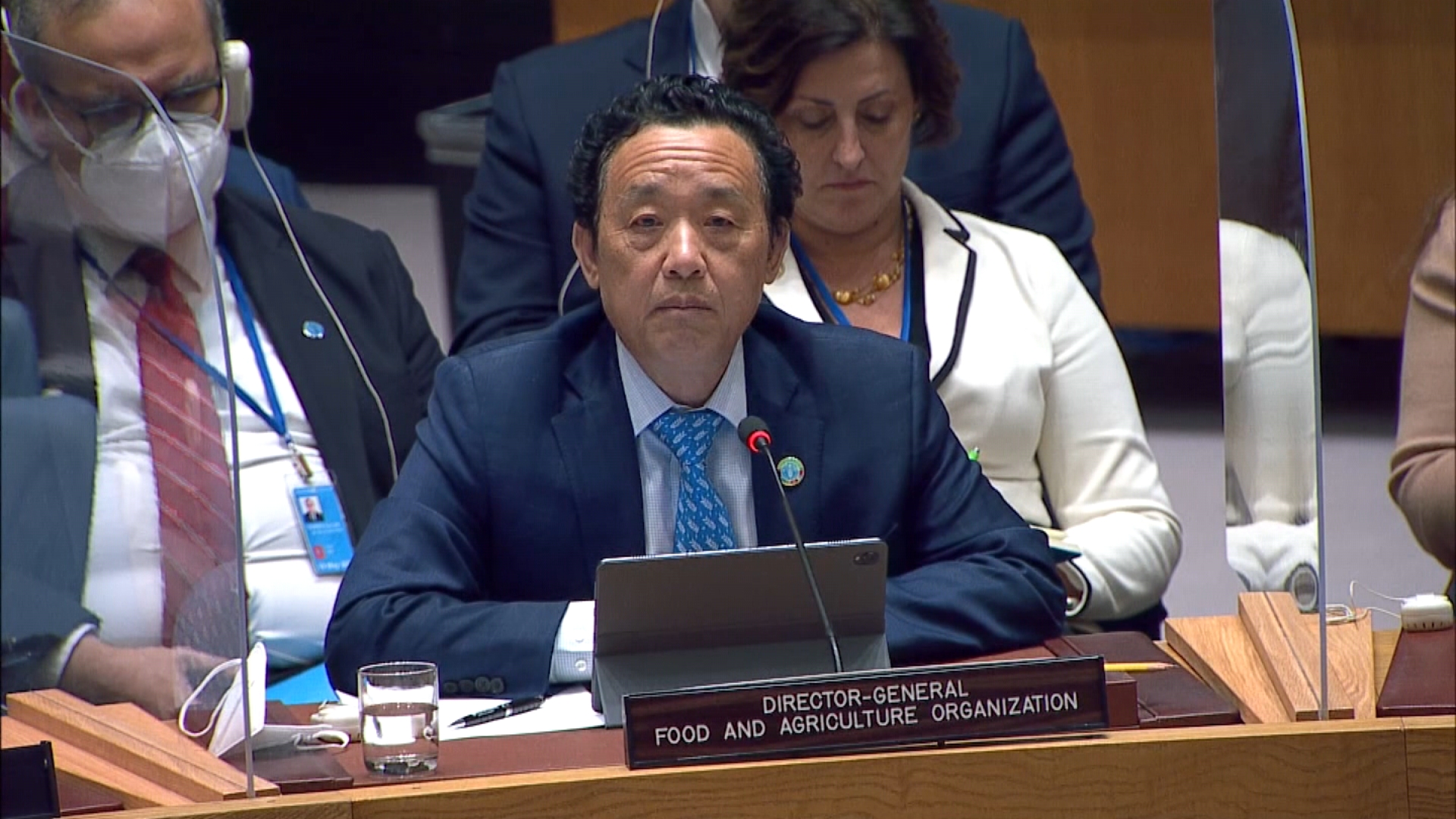
2. Wide shot, conference room, QU and other principals at the dais
3. SOUNDBITE (English) QU Dongyu, FAO Director-General:
“Hunger is not inevitable. With strong economic policies, social protection and sustained investments in more efficient, more inclusive, more resilient and more sustainable agrifood systems, we can bend the hunger curve.”
4. Wide shot, conference room, QU and other principals at the dais
5. SOUNDBITE (English) QU Dongyu, FAO Director-General:
“Current projections suggest that approximately up to 520 million people could still face hunger in 2030. But these projections do not fully capture the potential effects of a very strong El Niño, or the latest reductions in development and humanitarian financing. The downside risk is therefore huge.”
6. Wide shot, conference room, QU and other principals at the dais
7. SOUNDBITE (English) QU Dongyu, FAO Director-General:
“Nutritious foods remain expensive largely because costs accumulate beyond the farm, through storage, processing, transport and retail. Poor roads, inadequate cold chains, unreliable energy and inefficient markets raise the price of fruits, vegetables and animal source foods. Making healthy diets affordable therefore requires targeted investment across the entire value chain, combined with support for vulnerable households. This means the challenge is not only to produce more food, but to ensure that nutritious food can move efficiently and affordably from producers to consumers.”
8. Wide shot, conference room, QU and other principals at the dais
9. SOUNDBITE (English) QU Dongyu, FAO Director-General:
“We must act now. We must keep markets for food, energy and agricultural inputs open. We must avoid export restrictions. We must protect vulnerable households through targeted social protection. We must help farmers obtain fertilizers, seeds, water and other agricultural inputs, as well as credit, before planting decisions become irreversible. And we must invest in agrifood systems infrastructure on irrigation, storage, cold chains, transport, early warning and anticipatory action.”
10. Wide shot, conference room, QU and other principals at the dais
11. SOUNDBITE (English) QU Dongyu, FAO Director-General:
“In a world of ongoing and overlapping shocks, progress cannot be taken for granted; it must be protected, accelerated and extended to everyone, everywhere to ensure the Four Betters: better production, better nutrition, a better environment and a better life – leaving no one behind. Food security and diversity are fundamental rights for human beings!”
12. Wide shot, principals on dais applauding
13. Wide shot, delegates in room applauding
“We can bend the hunger curve,” the Director-General of the Food and Agriculture Organization of the United Nations (FAO), QU Dongyu, said today (21 Jul) at the launch of the 2026 edition of The State of Food Security and Nutrition in the World (SOFI) report, hailing three consecutive years of progress in reducing global hunger.
According to the SOFI report, an estimated 645 million people (7.8 percent of the global population) faced hunger in 2025. This represents nearly 14 million fewer people than in 2024 and 43 million fewer than at the 2022 peak.
Food insecurity also improved substantially. In 2025, approximately 2.1 billion people experienced moderate or severe food insecurity, nearly 86 million fewer people than one year earlier. The largest gains were recorded in South America and Asia, particularly in Southern Asia.
Speaking at the launch event at FAO's headquarters in Rome, Qu said the report's findings demonstrate that determined policy action can deliver results.
“Hunger is not inevitable,” the Director-General said. “With strong economic policies, social protection and sustained investments in more efficient, more inclusive, more resilient and more sustainable agrifood systems, we can bend the hunger curve.”
The launch event also saw contributions from the heads of three of the four UN agencies that helped FAO compile the report - Alvaro Lario, President of the International Fund for Agricultural Development (IFAD); Tedros Adhanom Ghebreyesus, Director-General of the World Health Organization (WHO); and Carl Skau, Acting Executive Director of the of the World Food Programme (WFP).
Despite the positive trends highlighted in this year's edition of SOFI, the report warns that progress remains uneven and vulnerable to multiple shocks.
Africa, for instance, recorded an important turning point, with the prevalence of hunger declining from 20.3 percent in 2024 to 20.0 percent in 2025, marking the first interruption of the continent’s upward hunger trend since 2017. However, approximately 309 million people in Africa remain undernourished, and rapid population growth means the absolute number of hungry people could still increase in the coming years.
Globally, the outlook remains concerning. Despite recent progress, the report projects that around 520 million people could still face hunger in 2030, putting the world off track to achieve Sustainable Development Goal 2 (Zero Hunger). This estimate may underestimate risks because it does not fully account for the potential impacts of a strong El Niño event or recent reductions in development and humanitarian financing, FAO's Director-General warned.
Qu noted that hunger is only one dimension of the global food security challenge: Nearly one-third of the world’s population remains unable to afford a healthy diet, exposing millions to malnutrition and diet-related non-communicable diseases.
QU Dongyu also said, “Nutritious foods remain expensive largely because costs accumulate beyond the farm, through storage, processing, transport and retail. Poor roads, inadequate cold chains, unreliable energy and inefficient markets raise the price of fruits, vegetables and animal source foods. Making healthy diets affordable therefore requires targeted investment across the entire value chain, combined with support for vulnerable households. This means the challenge is not only to produce more food, but to ensure that nutritious food can move efficiently and affordably from producers to consumers.”
In his address, Director-General called for urgent action to sustain and accelerate recent gains.
Key priorities include keeping food, energy and agricultural input markets open, avoiding export restrictions, and strengthening targeted social protection programmes for vulnerable populations. Governments and development partners are also urged to ensure farmers can access fertilizers, quality seeds, water, credit and other essential inputs before planting decisions become irreversible.
Longer-term investments are needed across agrifood systems, particularly in irrigation, storage facilities, cold chains, transport infrastructure, early-warning systems and anticipatory action mechanisms. Such investments can reduce the cost of nutritious foods, improve resilience to shocks and make healthy diets more affordable.
"In a world of ongoing and overlapping shocks, progress cannot be taken for granted; it must be protected, accelerated and extended to everyone, everywhere to ensure the Four Betters: better production, better nutrition, a better environment and a better life – leaving no one behind," Qu said.
During a panel discussion, several government ministers shared their countries' experiences in fighting hunger and malnutrition, including José Ignacio Paliza, Minister of the Presidency of the Dominican Republic; Cheikhou Oumar Ba, Minister for Agriculture, Food Sovereignty and Livestock of Senegal; and Abdurakhmonov Ibrokhim Yulchievich, Minister for Agriculture of Uzbekistan. Fernanda Machiaveli Morão De Oliveira, Minister for Agrarian Development and Family Agriculture of Brazil, provided closing remarks.
Download
There is no media available to download.