Media Home
 UN Web TV
 UN Audiovisual Library
 UN Photo
Unifeed
HAITI / HURRICANE SEASON
STORY: HAITI / HURRICANE SEASON
TRT: 2.01
SOURCE: MINUSTAH
RESTRICTIONS: NONE
LANGUAGE: CREOLE/ NATS
DATELINE: 3 JUNE 2009, GONAIVES, HAITI
1. Wide shot, danger sign at work site
2. Wide shot, tractor behind a bridge on the river Laquinte
3. Wide shot, river Laquinte outside Gonaives
4. Med shot, tractor pan down to river
5. SOUNDBITE (Creole) Gary Dupiton, Government Engineer:
“Our objective is to protect the city of Gonaives. When it rains, the water from the river basin surges through the river, and it breaks its walls. Then it enters the city – it’s the natural route for the water.”
6. Pan right, city street pan to drainage system
7. Med shot, men working on the city drains
8. Wide shot, city drains and workers
9. SOUNDBITE (Creole) Jean François Adolphe, Assistant Mayor of Gonaïves:
“Compared to Hurricane Jean in 2004, which caused 2,800 deaths, last year’s hurricanes Hanna and Ike caused only 600 deaths – or six times less. We are working to make sure that this year, even if there is material damage, there are no deaths.”
10. Wide shot, street pan down to clogged drain
11. Wide shot, clogged drainage canal
12. Tilt up, dirty blocked canal to a barber shop
13. Med shot, barber cutting hair
14. SOUNDBITE (Creole) Absolu Wilguens, Barber:
“I think that even if the water comes back this year, I feel safe. I can see there is good work being done.”
15. Pan left, drainage canal pan to men chatting in an outdoor lotto shop
16. Med shot, man’s face
17. SOUNDBITE (Creole) Sylvio Dangervil, Resident:
“Nothing much has really been done. If the water comes back it will be a disaster. The work done so far is not going to protect anyone, neither their house nor their life. They are working too slowly!”
18. Wide shot, mountains over a dike wall
19. Wide shot, river water
SCRIPT:
Since April, government engineers have been enlarging the River Laquinte as Haiti’s northern city of Gonaives struggles to prepare itself for this year’s hurricane season, which officially began on the first day of June. Overflow from this river cause major destruction in the city in 2004 and again in 2008.
Heavy machinery is reinforcing the walls and digging out the riverbed along 12 kilometers of river banks. Wider dike walls will better control the flow of water from more than 675 kilometers of river basin
SOUNDBITE (Creole) Gary Dupiton, Government Engineer:
“Our objective is to protect the city of Gonaives. When it rains, the water from the river basin surges through the river, and it breaks its walls. Then it enters the city, it’s the natural route for the water.”
The concept is simple – increase the river’s capacity to hold large quantities of water. Currently the river can hold only 150 cubic meters of water per second. But engineers intend to increase that by eight-fold.
For engineers, the only worry is getting the project finished before the rains begin. 17 mechanical diggers are working at a pace of 600 meters per week. In six weeks, they have enlarged the river across 3.6 kilometers.
Inside Gonaïves, the state is also building 14 massive drains, to quickly divert floodwaters out to the sea. Progress has been slow; drain construction has been underway since 2004 with no end in sight. Local officials still expect flooding, but hope for a lower death toll than in previous years.
SOUNDBITE (Creole) Jean François Adolphe, Assistant Mayor of Gonaïves:
“Compared to Hurricane Jean in 2004, which caused 2,800 deaths, last year’s hurricanes Hanna and Ike caused only 600 deaths – or six times less. We are working to make sure that this year, even if there is material damage, there are no deaths.”
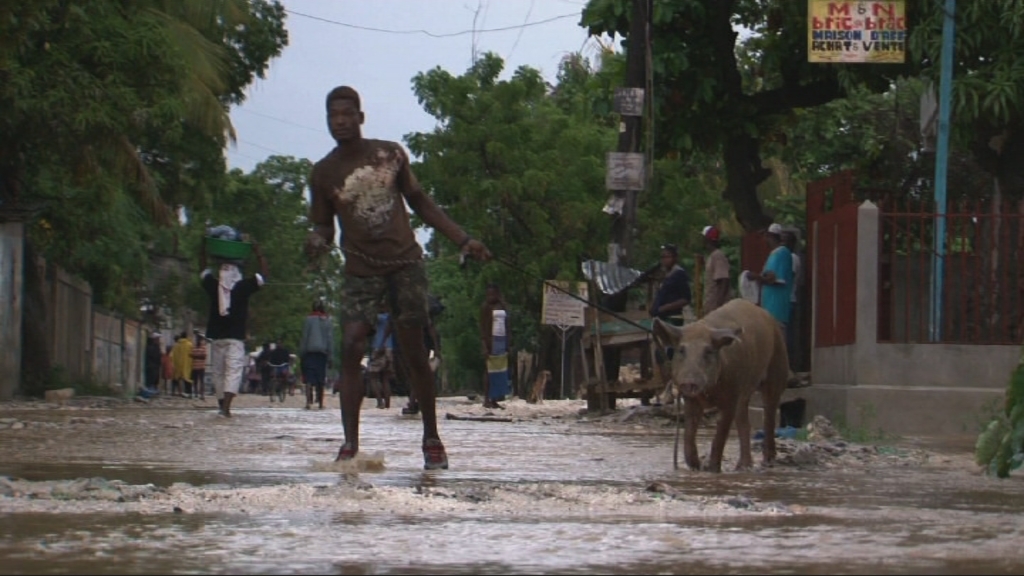
Despite these major projects, the city has not yet fully recovered from last year’s deadly hurricanes. Mud still blankets the city. Garbage clogs many drainage canals, leaving them nearly full of dirty water. In mid-May, Gonaives residents panicked when rain waters swelled in the river, nearly breaching the banks. But some people are putting all their hope in the state’s construction projects.
SOUNDBITE (Creole) Absolu Wilguens, Barber:
“I think that even if the water comes back this year, I feel safe. I can see there is good work being done.”
Not everyone is so optimistic. In the last five years, Gonaives has been destroyed twice, killing thousands and destroying millions of dollars of property. Though the government and international community have spent $10 million to protect the city, some residents feel it’s too little, too late.
SOUNDBITE (Creole) Sylvio Dangervil, Resident:
“Nothing much has really been done. If the water comes back it will be a disaster. The work done so far is not going to protect anyone, neither their house nor their life. They are working too slowly!”
For now, the population is waiting anxiously for the coming rains, to see if the state’s efforts to protect Gonaives will pass nature’s ultimate test.
Download
There is no media available to download.