Media Home
 UN Web TV
 UN Audiovisual Library
 UN Photo
Unifeed
GENEVA / DISASTER RISK REDUCTION
STORY: GENEVA / DISASTER RISK REDUCTION
TRT: 2.13
SOURCE: UNTV / UNISDR
RESTRICTIONS: NONE
LANGUAGE: ENGLISH / NATS
DATELINE: 19 JUNE 2009, GENEVA, SWITZERLAND/ FILE
SHOTLIST– RECENT, GENEVA SWITZERLAND
1. Wide shot, exterior Palais des Nations, 19 JUNE 2009, GENEVA, SWITZERLAND
19 JUNE 2009, GENEVA, SWITZERLAND
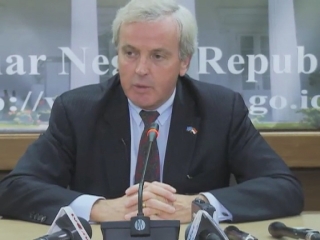
2. Wide shot, Press Room III, Palais des Nations.
3. SOUNDBITE (English) John Holmes, UN Under-Secretary-General for Humanitarian Affairs:
“The overall target is one of reducing deaths from disasters by 50 percent by the year 2015, which is a very ambitious target, not least if you consider that we expect the number of disasters, the intensity of disasters to be going up because of climate change. Nevertheless we were keen to set ourselves that ambitious target and also at the same time to reduce significantly the economic losses, the effects on people's livelihoods.”
FILE – UNISDR – UNDATED, UNKNOWN LOCATION
3. Various shots, tropical cyclone
4. Various shots, cyclone damage
19 JUNE 2009, GENEVA, SWITZERLAND
5. SOUNDBITE (English) John Holmes, UN Under-Secretary-General for Humanitarian Affairs:
“We set the targets of having by next year some clear national and international financing commitments including at least ten percent of all humanitarian and reconstruction funding to be devoted to funding disaster risk reduction and at least 30 percent of climate change adaptation funding to be devoted to the effects of climate change.”
FILE – UNISDR – UNDATED, UNKNOWN LOCATION
6. Various shots, wild fires
FILE – UNISDR – RECENT, PAKISTAN
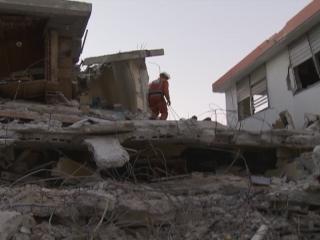
7. Various shots, earthquake aftermath and rescue efforts
19 JUNE 2009, GENEVA, SWITZERLAND
8. SOUNDBITE (English) John Holmes, UN Under-Secretary-General for Humanitarian Affairs:
“A second specific target was by 2011 that all schools and hospitals around the world should be assessed structurally for their resistance to disasters and that in a linked way by 2015, again, disaster risk reduction should be included in all schools' curricula in disaster- prone countries, in particular. And thirdly also by 2015, all major cities in disaster-prone areas should include and enforce disaster risk reduction measures in their building and land-use configuration and arrangements.”
9. Close up, photographer
10. Med shot, journalist typing
A major conference on Disaster Risk Reduction ended in Geneva today, with a call on governments to work on reducing by half the number of deaths from natural disasters, by the year 2015.
The conference – which was chaired by the UN Under-Secretary-General for Humanitarian Affairs, John Holmes – identified, among its key recommendations, the need for a global structural evaluation of schools and hospitals to make them safer, especially in all disaster-prone countries.
SOUNDBITE (English) John Holmes, UN Under-Secretary-General for Humanitarian Affairs:
“The overall target is one of reducing deaths from disasters by 50 percent by the year 2015, which is a very ambitious target, not least if you consider that we expect the number of disasters, the intensity of disasters to be going up because of climate change. Nevertheless we were keen to set ourselves that ambitious target and also at the same time to reduce significantly the economic losses, the effects on people's livelihoods.”
The recommendations also include the need for appropriate measures to be enforced in building and land codes for all major cities in disaster-prone areas of the world, by the year 2015.
SOUNDBITE (English) John Holmes, UN Under-Secretary-General for Humanitarian Affairs:
“We set the targets of having by next year some clear national and international financing commitments including at least ten percent of all humanitarian and reconstruction funding to be devoted to funding disaster risk reduction and at least 30 per cent of climate change adaptation funding to be devoted to the effects of climate change.”
Most importantly, the conference recommends that clear financial commitments to disaster risk reduction should be established nationally and internationally by the end of next year.
SOUNDBITE (English) John Holmes, UN Under-Secretary-General for Humanitarian Affairs:
“A second specific target was by 2011 that all schools and hospitals around the world should be assessed structurally for their resistance to disasters and that in a linked way by 2015, again, disaster risk reduction should be included in all schools' curricula in disaster- prone countries, in particular. And thirdly also by 2015, all major cities in disaster-prone areas should include and enforce disaster risk reduction measures in their building and land-use configuration and arrangements.”
Last year, 236,000 people lost their lives in over 300 disasters – in earthquakes, floods, storms, landslides and other destructive events. More than 200 million people were directly affected, and damages exceeded 180 billion US dollars.
The world’s combined disaster management mechanisms can assist at most 100 million people at any one time, while the projected need is three times that figure.
Download
There is no media available to download.