Media Home
 UN Web TV
 UN Audiovisual Library
 UN Photo
Unifeed
HAITI / SEISMIC ASSESSMENT
STORY: HAITI / SEISMIC ASSESSMENT
TRT: 3.38
SOURCE: MINUSTAH
RESTRICTIONS: NONE
LANGUAGE: ENGLISH/ FRENCH/ NATS
DATELINE: 16 FEBRUARY 2010, PORT AU PRINCE, HAITI
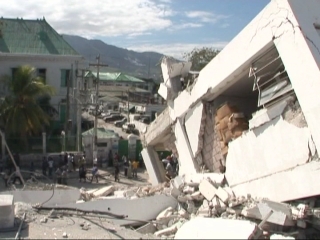
1. Wide shot, busy street with damaged buildings
2. Med shot, people passing underneath a destroyed building
3. Close up, pieces of stone from damaged building hanging above street
4. Wide shot, damaged lottery agency
5. Tilt up, from shop onto cracked wall
6. SOUNDBITE (French) Jean, Lottery Agent:
“I am afraid of working here, but I don’t have a choice. If I stay at home nobody is going to give me anything.”
7. Wide shot, vehicle passing by workers on the street
8. Close up, workers passing over stones
9. Wide shot, workers standing on rubble
10. Zoom out, from Traffic sign onto street with rubble in foreground
11. Wide shot, drive through collapsed rubble on road side
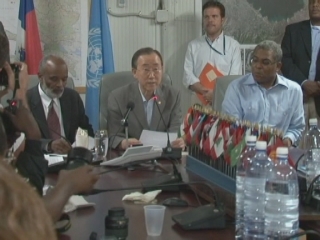
12. Wide shot, meeting of international experts with map of Port au Prince in foreground
13. Close up, Andrew Morton, project manager for UNEP talking
14. Close up, international experts listening
15. Wide shot, back shot of meeting
16. Pan right, semi collapsed wall onto Andrew Morton passing by
17. SOUNDBITE (English) Andrew Morton, United Nations Environmental Program project manager:
“It’s very dangerous to talk about predictions of earthquake. But in summary the best signs show that there is reasonable likelihood that we will have a big earthquake within the next ten, fifty, one hundred years. Now the important thing about that number is within the lifetime of the buildings that we will go up now and the ones that still exist. So the buildings need to be prepared for that earthquake.”
18. Wide shot, walking shot Eric Calais, French geologist carrying ladder
19. Med shot, Calais climbing up
20. Med shot, Eric Calais opening yellow case
21. Close up, needle of the instrument on the roof
22. Med shot, geological instrument
23. Tilt up, geological instruments onto Eric Calais standing above
24. Med shot, geological instrument in yellow geological boxes
25. SOUNDBITE (French) Eric Calais, French geologist:
“In fact it’s the entire country which was affected by the earthquake, even though the major shakes are in the zone of Port au Prince to Leogane. We are trying to measure these shakes with GPS.”
26. Tilt up, bunch of yellow geological cases onto Eric Calais with Haitian professor talking
27. Med shot, Calais and Roberte Bien Aimee, Haitian professor in seismology
28. Close up, hands on the map
29. Med shot, Calais and Bien Aimee through pile of yellow boxes
30. SOUNDBITE (French) Roberte Bien Aimee, Haitian professor in seismology:
“An earthquake of this magnitude 7.3 it was the first time. Even if it were magnitude 5, it would have been the first time. We had already felt small shakes before. So this was a sign announcing a major earthquake. But there we were not ready.”
31. Wide shot, interior of supermarket
32. Med shot woman onto cashier scanning bread
33. Med shot, customers in an aisle
34. Wide shot, worker arranging bottles on shelf
35. Wide shot, exterior of supermarket onto damaged building
36. Close up, cracked wall
37. Zoom out, from sign of building onto worker fixing the wall
A UN report compiled by a group of thirty scientists assessing the risk of earthquakes, landslides and tsunamis in Haiti says there is a high probability of another earthquake of at least the same magnitude within the next 100 years.
The findings of the report which is expected to be released next Friday will be a crucial factor to be taken into account before a rebuilding effort begins.
Although there is a clear and immediate danger of collapse with rubble hanging over busy streets of Port au Prince, many Haitians have returned inside cracked walls as they need to keep on working.
SOUNDBITE (French) Jean, Lottery Agent:
“I am afraid of working here, but I don’t have a choice. If I stay at home nobody is going to give me anything.”
According to the United Nations, if 1.2 million people are currently living in shelters, there are at least 2 million additional people affected by the earthquake and threatened by falling rubble.
Andrew Morton of the United Nations Environment Program (UNEP), responsible for the report, warned that every damaged building which has not yet collapsed will probably do so, with people who have returned to cracked houses in their homes or work buildings facing a great danger.
SOUNDBITE (English) Andrew Morton, United Nations Environmental Program project manager:
“It’s very dangerous to talk about predictions of earthquake. But in summary the best signs show that there is reasonable likelihood that we will have a big earthquake within the next ten, fifty, one hundred years. Now the important thing about that number is within the lifetime of the buildings that we will go up now and the ones that still exist. So the buildings need to be prepared for that earthquake.”
A team of experts from across the world are currently installing instruments to analyze the shifts of the earth. The French geologist Eric Calais has already been placing GPS to measure the effects of the fracture.
SOUNDBITE (French) Eric Calais, French geologist:
“In fact it’s the entire country which was affected by the earthquake, even though the major shakes are in the zone of Port au Prince to Leogane. We are trying to measure these shakes with GPS.”
The Haitian fracture has already been the subject of long studies by Haitian experts. Roberte Bien Aimee, a professor of seismology at the University of Port au Prince, had already done a thesis on the Haitian fracture as a student.
SOUNDBITE (French) Roberte Bien Aimee, Haitian professor in seismology:
“An earthquake of this magnitude 7.3 it was the first time. Even if it were magnitude 5, it would have been the first time. We had already felt small shakes before. So this was a sign announcing a major earthquake. But there we were not ready.”
The joint Haitian national and international taskforce was formed under the auspices of the United Nations to analyze the earthquake of January 12th and to provide advice to the government and public to reduce ongoing risks and to guide the recovery process.
Another report undertaking urgent data collection to enable a more informed analysis and forecast will be delivered at end of March. The outputs of the taskforce will be made available to the public on a dedicated website.
Download
There is no media available to download.