Media Home
 UN Web TV
 UN Audiovisual Library
 UN Photo
Unifeed
JAMAICA / CYBER CRIME
Download
There is no media available to download.
STORY: JAMAICA / CYBER CRIME
TRT: 9:24
SOURCE: 21ST CENTURY, WCCO TV, CMV TV JAMAICA, THE STAR-LEDGER, NEW JERSEY
RESTRICTIONS: NONE
LANGUAGE: ENGLISH / NATS
DATELINE:
APRIL 2010, TEXAS, UNITED STATES OF AMERICA
1.Med shot, Maria Guerra looking ahead
2.Wide shot, sunset
3.SOUNDBITE (English) Maria Guerra, victim of cyber crime:
“It started with a very nice call congratulating me that I had won 3.8 million dollars.”
4. Wide shot, mountains
5. Various shots, Maria Guerra standing by the mountains looking at the sunset
6. SOUNDBITE (English) Maria Guerra, victim of cyber crime:
“I trusted them. I gave all my trust to them. And it got to the point to where they would call me on a daily basis, three or four times, to see if I could get any money.”
7. Close up, table with documents and a cell phone ringing
8. Wide shot, Maria Guerra on the phone seen through a beaded curtain
9. Close up, documents
10. SOUNDBITE (English) Maria Guerra, victim of cyber crime:
“…she did. She won one million dollars.”
11. Med shot, Maria Guerra sitting by a table at her home and seen from behind a beads curtain
APRIL 2010, JAMAICA
12. Various shots, Jamaican landscapes
13. SOUNDBITE (English) Superintendent Fitz Bailey, Head, Organized Crime Unit, Jamaica:
“The fact is with globalization there is no border really to crime. It’s transnational.”
14. Various shots, Bailey on the phone
SOUNDBITE (English) Superintendent Fitz Bailey, Head, Organized Crime Unit, Jamaica:
“And I guessed what is happening in Jamaica is just the pattern that is happening right across the globe.”
APRIL 2010, JAMAICA
15. SOUNDBITE (English) Superintendent Fitz Bailey, Head, Organized Crime Unit, Jamaica:
“Unscrupulous individuals in Jamaica obtain data of overseas citizens … the listing gives biographical data.”
16. Various shots, Maria walking by the harbour
17. Wide shot, flags
APRIL 2010, TEXAS, UNITED STATES OF AMERICA
18. Med shot, Maria Guerra crying
19. SOUNDBITE (English) Maria Guerra, victim of cyber crime:
“…I used all my money. And it’s my fault. The money they loaned me … it was a lot.”
20. Various shots, roads and highways with traffic
21. SOUNDBITE (English) Maria Guerra, victim of cyber crime:
“… then they started knocking at the door, and they wanted their money, so I isolated myself. I stopped going to the stores.”
22. Various shots, Maria Guerra driving
23. SOUNDBITE (English) Maria Guerra, victim of cyber crime:
“I stopped going to the movies, I stopped going to the gym. I started just not turning on the lights. I started living in the dark.”
24. Wide shot, facade of Maria Guerra’s house
25. Maria Guerra looking at TV
26. SOUNDBITE (English) Maria Guerra, victim of cyber crime:
“…and then one day, he just threw me out of the house. I ended up at the centre where homeless people live”.
27. Med shot, Maria Guerra walking
28. SOUNDBITE (English) Maria Guerra, victim of cyber crime:
”I had to get in line to get a shower. I had to get in line for a ticket to have a meal. I was ashamed.”
29. Various shots, Maria Guerra at the homeless centre
APRIL 2010, NEW JERSEY, UNITED STATES OF AMERICA
30. Med shot, police situation
31. Wide shot, facade of Ann’s house
APRIL 2010, JAMAICA
32. SOUNDBITE (English) Karen Harrison, investigator, Financial Crimes Unit, Jamaica:
“…after she received notices that she is the winner of 2.5 million dollars she had further instructions on how to send money in order to collect her winnings.“
33. Wide shot, Harrison at work
34. SOUNDBITE (English) Karen Harrison, investigator, Financial Crimes Unit, Jamaica:
“She became convinced that, yes, the money is there for me to win.”
35. Various shots, Harrison at work
36. Various shots, images of Jamaica
37. SOUNDBITE (English) Karen Harrison, investigator, Financial Crimes Unit, Jamaica:
“After a while she realized that all these calls were just fictitious, and it was a scam and she became so depressed, she became reclusive. And eventually she reached a stage where she took her own life.”
38. Various shots, airport, planes
39. Various shots, beach images of Montego Bay
40. SOUNDBITE (English) Superintendent Fitz Bailey, Head, Organized Crime Unit, Jamaica:
“Some of our major narcotics players were actually extradited to the United States. It created a vacuum. The lottery scam, I believe, has actually filled that vacuum.”
41. Various shots, Montego Bay town
42. Various shots, faded images of men in the streets
43. SOUNDBITE (English) Karen Harrison, investigator, Financial Crimes Unit, Jamaica:
“They would set up something like what you’d call a boiler room. You go into this room you will see cell phones set up, laptops. People paid to make these phone calls, so it’s like they’ve set up a genuine business. And the sole intention of that business is to run the lottery scam.”
44. Various shots, of Montego Bay town from a moving car
45. SOUNDBITE (English) Superintendent Fitz Bailey, Head, Organized Crime Unit, Jamaica:
“It is providing significant amounts of wealth to the perpetrators. You can see a manifestation of this in the type of houses that are built, the lifestyle that these guys demonstrate. It’s very lavish.”
46. Tracking shot, mansions
47. Wide shot, riding a water scooter
48. Close up, image through camera lens
DATE UNKNOWN, JAMAICA / CMV TV JAMAICA
46. SOUNDBITE (English) Scameisha:
“Young men, fourteen, thirteen years old – they are millionaires. And they are their own boss. They have two-storey houses … they have everything“.
APRIL 2010, JAMAICA
49. Various shots, expensive sports cars and parties images
50. SOUNDBITE (English) Superintendent Fitz Bailey, Head, Organized Crime Unit, Jamaica:
“These guys who participate in the lottery scam, they meet where they actually burn money to see who can burn the most money.”
GRAPH
51. Med shot, one hundred dollar bill burning
APRIL 2010, JAMAICA
52. Wide shot, Montego bay at night
53. SOUNDBITE (English) Superintendent Fitz Bailey, Head, Organized Crime Unit, Jamaica:
“We have identified over 200 murders that are linked directly or indirectly to the lottery scam in the Western part of our island – that is Montego Bay.”
54. Various shots, Montego Bay at night
APRIL 2010, TEXAS, UNITED STATES OF AMERICA
55. Wide shot, Maria Guerra getting off her car
56. Wide shot, exterior of the Government Department of Homeland Security
FILE / STILL - THE STAR-LEDGER / DATE UNKNOWN
57. Zoom in, picture of jolt workers
APRIL 2010, JAMAICA
58. SOUNDBITE (English) Vance Callendar, Attaché to the U.S. Embassy, Kingston, JAMAICA:
“We have several agents that are temporarily assigned for long-term duty in Jamaica to work solely on these cross-border financial crimes.”
59. Zoom in, Callendar picture
60. Wide shot, exterior Jamaican authorities building
61. SOUNDBITE (English) Vance Callendar, Attaché to the U.S. Embassy, Kingston, JAMAICA:
“We have a tremendous effort underway right now. We’re already seeing the fruits of our labour. They’re starting to learn that they can be reached in another country; that they can be held accountable for their crimes.”
62. Various shots, Jolt agents confiscating material and arresting ringleaders arrest
63. Close up, documents
FILE / WCCO TV / DATE UNKNOWN
64. Various shots, Jolt agents confiscating material
APRIL 2010, JAMAICA
65. Various shots, Sergeant Patrick Linton at work
66. SOUNDBITE (English) Sergeant Patrick Linton head, Jamaican Constabulary’s Cyber Crime Investigation and research Unit, Jamaica:
“Although we do have a Cyber Crime Act, it’s not signed as yet by the Governor General. But as soon as we realize the Cyber Crime Act, we will be prosecuting persons…”
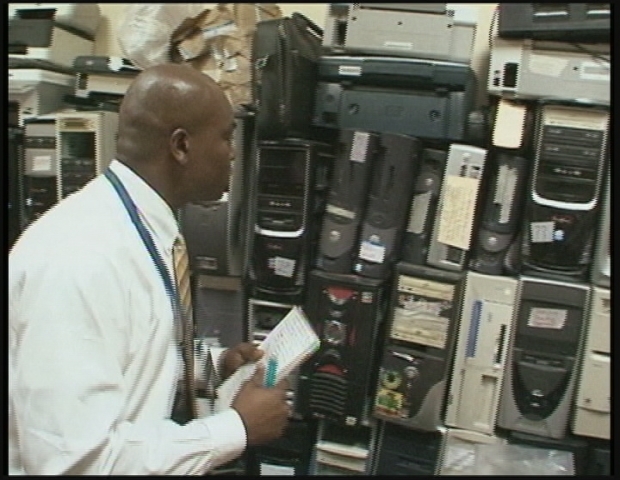
67. Various shots, Linton at work checking computers confiscated
68. Various shots, police Jamaican station
69. Various shots, Linton at work
70. SOUNDBITE (English) Sergeant Patrick Linton, head, Constabulary’s Cyber Crime Investigation and research Unit, Jamaica:
“Tesha is now conducting an investigation using forensics in a lottery scam case.”
71. Wide shot, Harrison at work
APRIL 2010, TEXAS, UNITED STATES OF AMERICA
72. Various shots, Marian Guerra walking the dog
73. SOUNDBITE (English) Maria Guerra, victim of cyber crime:
“I learned from my mistakes. Everybody makes mistakes, I’m human. My kids were the ones who told me, ‘Mum, if you win something…you don’t have to pay to get the money that you won.’”
SOUNDBITE (English) Maria Guerra, victim of cyber crime:
“It started with a very nice call congratulating me that I had won 3.8 million dollars.”
Fifty-two-year-old Maria Guerra lives in Texas. She’s working three jobs just to make ends meet. It is not the life she expected when she got that “very nice call.”
SOUNDBITE (English) Maria Guerra, victim of cyber crime:
“I trusted them. I gave all my trust to them. And it got to the point to where they would call me on a daily basis, three or four times, to see if I could get any money.”
The callers were asking for cash to pay for what they said were customs, processing fees, and taxes on the prize money.
Maria believed she could be rich like her sister who had just won the Texas lottery.
SOUNDBITE (English) Maria Guerra, victim of cyber crime:
“…she did. She won one million dollars.”
But for Maria there was no money to win. She was a victim of a lottery scam well known to investigators in the Caribbean island nation of Jamaica where the perpetrators were based.
SOUNDBITE (English) Superintendent Fitz Bailey, Head, Organized Crime Unit, Jamaica:
“The fact is with globalization there is no border really to crime. It’s transnational.”
Superintendent Fitz Bailey is the Head of the Organized Crime Unit in Jamaica.
SOUNDBITE (English) Superintendent Fitz Bailey, Head, Organized Crime Unit, Jamaica:
“And I guessed what is happening in Jamaica is just the pattern that is happening right across the globe.”
It’s called cyber crime; criminals using the internet for unprecedented access to victims worldwide. In the lottery fraud, scammers used a technique known as data mining.
SOUNDBITE (English) Superintendent Fitz Bailey, Head, Organized Crime Unit, Jamaica:
“Unscrupulous individuals in Jamaica obtain data of overseas citizens the listing gives biographical data.”
The scammers knew how to pressure Maria to pay their fees – fees that would drain her life’s savings and would never deliver the millions she hoped for.
Maria even borrowed money from friends and relatives.
NATSOT – MARIA CRYING
SOUNDBITE (English) Maria Guerra, victim of cyber crime:
“I used all my money. And it’s my fault. The money they loaned me it was a lot.”
Still Maria believed she had won a fortune. Her friends and family couldn’t convince her otherwise.
SOUNDBITE (English) Maria Guerra, victim of cyber crime:
“…then they started knocking at the door, and they wanted their money, so I isolated myself. I stopped going to the stores. I stopped going to the movies, I stopped going to the gym. I started just not turning on the lights. I started living in the dark.”
Maria’s husband could not stand her bizarre behaviour.
SOUNDBITE (English) Maria Guerra, victim of cyber crime:
“…and then one day, he just threw me out of the house. I ended up at the center where homeless people live”. I had to get in line to get a shower. I had to get in line for a ticket to have a meal. I was ashamed.”
Maria is not alone. Ann Mowle’s body washed ashore on a New Jersey beach. Police believed this 72-year-old grandmother may have been driven to suicide by her experience with the Jamaican lottery.
Callers told the former bookkeeper that she had won two and a half million dollars. The caller said all she had to do was claim her prize.
SOUNDBITE (English) Karen Harrison, investigator, Financial Crimes Unit, Jamaica:
“…after she received notices that she is the winner of 2.5 million dollars she had further instructions on how to send money in order to collect her winnings.“
Karen Harrison, an investigator with Jamaica’s Financial Crimes Unit, spoke with Anne several times about her case.
SOUNDBITE (English) Karen Harrison, investigator, Financial Crimes Unit, Jamaica:
“She became convinced that, yes, the money is there for me to win.”
Harrison discovered the scammers knew Ann’s name and address. They even knew about her fondness for sweepstakes, and that she had once won a trip to Jamaica.
By the time the con was over, Ann had lost her entire life savings – almost a quarter of a million dollars.
SOUNDBITE (English) Karen Harrison, investigator, Financial Crimes Unit, Jamaica:
“After a while she realized that all these calls were just fictitious, and it was a scam and she became so depressed, she became reclusive. And eventually she reached a stage where she took her own life.”
Montego Bay, in the western part of Jamaica, is where the frauds began. It’s the hub for a huge network of lottery scammers. The area used to be the heart of the drug trade, but now cyber crime is flourishing here.
SOUNDBITE (English) Superintendent Fitz Bailey, Head, Organized Crime Unit, Jamaica:
“Some of our major narcotics players were actually extradited to the United States. It created a vacuum. The lottery scam, I believe, has actually filled that vacuum.”
Like the drug traffickers they’ve replaced, the largest fraud operations are highly organized networks employing many people. There are list-makers, people who call victims, people to take calls, money collectors, security and financiers.
SOUNDBITE (English) Karen Harrison, investigator, Financial Crimes Unit, Jamaica:
“They would set up something like what you’d call a boiler room. You go into this room you will see cell phones set up, laptops. People paid to make these phone calls, so it’s like they’ve set up a genuine business. And the sole intention of that business is to run the lottery scam.”
And business is booming. According to US security officials, Jamaican scammers collected 30 million dollars from American citizens in 2008.
SOUNDBITE (English) Superintendent Fitz Bailey, Head, Organized Crime Unit, Jamaica:
“It is providing significant amounts of wealth to the perpetrators. You can see a manifestation of this in the type of houses that are built, the lifestyle that these guys demonstrate. It’s very lavish.”
A Jamaican reporter interviewed this anonymous insider.
SOUNDBITE (English) Scameisha:
“Young men, fourteen, thirteen years old – they are millionaires. And they are their own boss. They have two-storey houses … they have everything“.
At times, there are scenes of frenetic excess. Eyewitnesses say young people throw parties along a tiny road called the Hip Strip. There, expensive cars clog the street.
SOUNDBITE (English) Superintendent Fitz Bailey, Head, Organized Crime Unit, Jamaica:
“These guys who participate in the lottery scam, they meet where they actually burn money to see who can burn the most money.”
There is an even more sinister side to these scams. Organized crime and local gangs use their money to purchase weapons, leading to an escalation in violent crimes.
SOUNDBITE (English) Superintendent Fitz Bailey, Head, Organized Crime Unit, Jamaica:
“We have identified over 200 murders that are linked directly or indirectly to the lottery scam in the Western part of our island – that is Montego Bay.”
The violence, wealth and sophistication of Jamaican lottery rackets – and their ability to reach beyond borders to ensnare American citizens – has long been a concern to the United States Government Department of Homeland Security (DHS).
DHS joined forces with Jamaican authorities to create JOLT – Jamaican Operations Linked to Telemarketing.
SOUNDBITE (English) Vance Callendar, Attaché to the U.S. Embassy, Kingston, JAMAICA:
“We have several agents that are temporarily assigned for long-term duty in Jamaica to work solely on these cross-border financial crimes.”
Vance Callendar, Attaché to the U.S. Embassy in Kingston, was instrumental in carrying out the JOLT programme. He was also the primary liaison with Jamaican authorities.
SOUNDBITE (English) Vance Callendar, Attaché to the U.S. Embassy, Kingston, JAMAICA:
“We have a tremendous effort underway right now. We’re already seeing the fruits of our labour. They’re starting to learn that they can be reached in another country; that they can be held accountable for their crimes.”
In June 2009 JOLT agents in Jamaica launched a raid in the Montego Bay area. Hundreds of cell phones, computer equipment, and digital phone cards were confiscated.
Lottery fraud ringleaders were arrested. To date, 85 people have been apprehended and six indicted. JOLT has recovered over $750,000 for victims, including $10,000 for Maria.
NATSOT – RAID
But Jamaica’s prosecutors have been thwarted by legislation written for a pre-digital era.
Sergeant Patrick Linton heads the Jamaican Constabulary’s Cyber Crime Investigation and research Unit.
SOUNDBITE (English) Sergeant Patrick Linton, head, Jamaican Constabulary’s Cyber Crime Investigation and research Unit:
“Although we do have a Cyber Crime Act, it’s not signed as yet by the Governor General. But as soon as we realize the Cyber Crime Act, we will be prosecuting persons…”
Jamaican officials believe the new laws, prison terms and fines of up to two million dollars will cut into the thriving lottery scam and the criminality that it feeds. Initiatives spearheaded by the United Nations Office on Drugs and Crime, UNODC, are helping too. Law enforcement officers here have attended forensic computing workshops in order to keep ahead of the criminals.
SOUNDBITE (English) Sergeant Patrick Linton, head, Jamaican Constabulary’s Cyber Crime Investigation and research Unit:
“Tesha is now conducting an investigation using forensics in a lottery scam case…”
Investigators, with the help of family members in the United States, are still pursuing Ann’s case.
Maria is struggling to put her life back together. With her $10,000 she has begun paying back the money she borrowed.
Although she lost everything to the scam, she still gets lottery offers. But she’s a lot more cautious now.
SOUNDBITE (English) Maria Guerra, victim of cyber crime:
“I learned from my mistakes. Everybody makes mistakes, I’m human. My kids were the ones who told me, ‘Mum, if you win something…you don’t have to pay to get the money that you won.’”