Media Home
 UN Web TV
 UN Audiovisual Library
 UN Photo
Unifeed
UN / WORLD MENTAL HEALTH DAY ADVANCER
STORY: UN / WORLD MENTAL HEALTH DAY ADVANCER
TRT: 2.20
SOURCE: WHO
RESTRICTIONS: NONE
LANGUAGE: ENGLISH / NATS
DATELINE: 7 OCTOBER 2010 / FILE
RECENT GENEVA, SWITZERLAND
1. Wide shot, exterior WHO HQ
7 OCTOBER 2010, GENEVA, SWITZERLAND
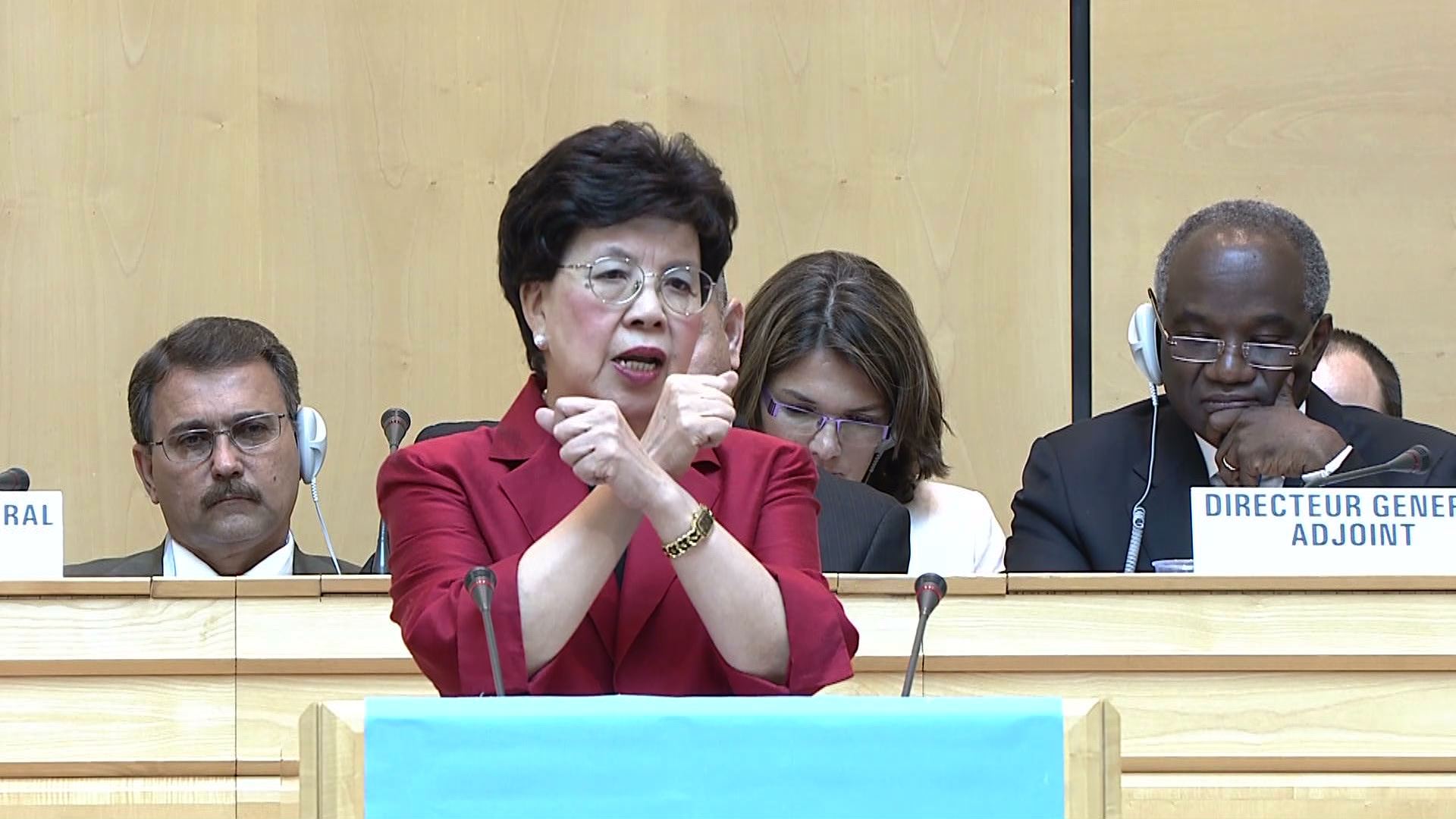
2. SOUNDBITE (English) Margaret Chan, Director General, WHO:
"Mental health problems, whether depression, epilepsy, dementia, or alcohol dependence, are real disorders. They cause death and disability. They cause suffering. They have symptoms. And they can be managed, in any resource setting. This is the message we can now communicate with confidence. No matter how weak the health system or how constrained the resources, something can always be done."
FILE / APRIL 2010, YINCHUAN PROVINCE, CHINA
3. Cutaways, nurse with patient
4. SOUNDBITE (English) Dr Shichuo Li, Association Against Epilepsy, China:
“We trained mainly the doctors working in the county and township so we had to educate them first. And also we had public education, for the people. We let them to know what is epilepsy”.
FILE / DECEMBER 2009, SCHIZOPHRENIA RESEARCH FOUNDATION (SCARF) CHENNAI, INDIA
5. Various shots, woman making mosaic pattern on ground
6. Various shots, woman making handicrafts
7. Various shots, men standing in mental institution
8. SOUNDBITE (English) Dr R. Thara, Doctor:
“My desire is that every Indian should be able to go somewhere close to his home and get mental health care.”
9. Cutaway, Suresh Sunderasan at work
10. SOUNDBITE Suresh Sunderasan, Person living with psychosis:
“My name is Suresh; I work as a quality assurance manager in a factory . thanks to my case manager maintains my records – I discuss my problems and she discusses with the doctors and give me medicine. I am normal now, thanks to my doctors.”
FILE / FEBRUARY 2010, CAPETOWN, SOUTH AFRICA.
11. Cutaway, Fait Jones and daughter Tara walking towards camara
12. SOUNDBITE (English) Faith Jones, mother of cerebral Palsy child:
“This is my daughter Tara and she is intellectually disabled. When I first started working with the cerebral palsy children you just bond with them. Each child responds differently if you know how to bond with that child, it’s just beautiful, you know what to do exactly at the right time.”
13. SOUNDBITE (English) Gadija Koopman, Cape Mental Health Society
“It is not about the money first. It is about the commitment, the love, the compassion, the world, to make a difference.”
Millions of people with common, but untreated, mental, neurological and substance use disorders can now benefit from new simplified diagnosis and treatment guidelines released today by WHO. The guidelines are designed to facilitate the management of depression, alcohol use disorders, epilepsy and other common mental disorders in the primary health-care setting.
The Intervention guide extends competence in diagnosis and management to non-mental health specialists including doctors, nurses and other health providers. These evidence-based guidelines are presented as flow charts to simplify the process of providing care in the primary health-care setting.
Almost 95 million people with depression do not receive any treatment or care.
The WHO estimates that more than 75% of people with mental, neurological and substance use disorders -- including nearly 95 million people with depression and more than 25 million people with epilepsy -- living in developing countries do not receive any treatment or care. Placing the ability to diagnose and treat them into the primary health care system will significantly increase the number of people who can access care.
An estimated one in four people globally will experience a mental health condition in their lifetime. People with mental, neurological and substance use disorders are often stigmatized and subject to neglect and abuse. The resources available are insufficient, inequitably distributed and inefficiently used. In the majority of countries, less than 2% of health funds are spent on mental health. As a result, a large majority of people with these disorders receive no care at all.
WHO in collaboration with partners will provide technical support to countries to implement the guidelines and has already initiated the program for scaling up care in six countries, Ethiopia, Jordan, Nigeria, Panama, Sierra Leone and Solomon Islands.
The Intervention guide will help scale up care for mental, neurological and substance use disorders - which is the aim of WHO mental health Gap Action Programme (mhGAP). Multiple partners including Member States, UN agencies, research institutes, universities, multilateral agencies, foundations, WHO Collaborating Centres and NGOs under the (mental health Gap Action Programme (mhGAP) Forum have agreed to assist WHO in advocating for improving mental health care and services in developing countries.
WHO through its mhGAP programme, calls on governments, donors and mental health stakeholders to rapidly increase funding and basic mental health services to close the huge treatment gap.
Download
There is no media available to download.