Media Home
 UN Web TV
 UN Audiovisual Library
 UN Photo
Unifeed
BANGLADESH / SAFE WATER
STORY: BANGLADESH / SAFE WATER
TRT: 2:26
SOURCE: IAEA
RESTRICTIONS: NONE
LANGUAGE: ENGLISH / NATS
DATELINE: AUGUST 2011, BANGLADESH
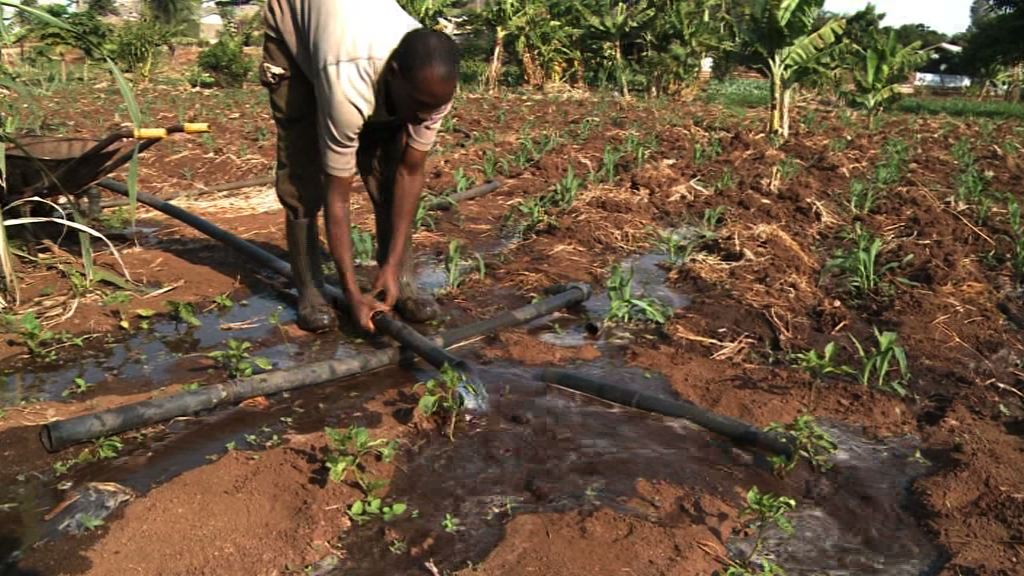
1. Close-up, water from traditional shallow well drilling method, Kishoreganj District
2. Med shot, man using traditional shallow well drilling method
3. Med shot, water from use of traditional shallow well drilling method
4. SOUNDBITE (English) M. Khaliquzzaman, Water Expert, World Bank:
“The arsenic issue was identified in the early 1990s in Bangladesh and roughly 35 percent of the country is infested with this problem. The amount of people involved is more than 50 million, so it was a huge problem.”
5. Med shot, man afflicted with effects of arsenicosis, Chapai Nawabganj
6. Wide shot, people living in Chapai Nawabganj
7. Close up, lesions on foot of man affected by arsenic poisoning
8. Pan down, lesions on foot of man affected by arsenic poisoning
9. SOUNDBITE (English) Yan Zheng, UNICEF:
“Arsenic is very interesting because it interacts with the cells and genes in many different ways. It is a toxin. It is probably one of the only environmental toxins that attacks more than one organ in the human body.”
10. Various shots, Nasir Ahmed from the Bangladesh Atomic Energy Commission conducting water sampling
11. Various shots, water analysis in Isotope Hydrology Laboratory at Bangladesh Atomic Energy Commission, Dhaka
12. SOUNDBITE (English) Nasir Ahmed, Bangladesh Atomic Energy Commission:
“The shallow aquifers are highly contaminated. Most of the areas in Bangladesh are highly contaminated, especially the shallow aquifers. That is one of the options the government is getting from isotopic results. The deep aquifer is only one of the solutions to provide safe and sustainable water supply to the rural people.”
13. Various shots, men working using deep well drilling method, Kishoreganj District
14. Various shots, women collecting water at a safe “green” well in village
Bangladesh's arsenic crisis came to light in 1993, after a number of people in villages across the country fell ill, and it was confirmed that their main source of drinking water, groundwater from the deltaic basin, was contaminated with arsenic.
SOUNDBITE (English) M. Khaliquzzaman, Water Expert, World Bank:
“The arsenic issue was identified in the early 1990s in Bangladesh and roughly 35 percent of the country is infested with this problem. The amount of people involved is more than 50 million, so it was a huge problem.”
In the early 1970s, most of Bangladesh's rural population got its drinking water from surface ponds and nearly a quarter of a million children died each year from waterborne diseases. The provision of tube well water for 97 percent of the rural population brought down the high incidence of diarrheal diseases and halved the infant mortality rate.
Paradoxically, the same wells that saved so many lives were later found to pose a threat due to the unforeseen hazard of arsenic. The arsenic contamination in Bangladesh has natural causes: arsenic is mobilized into the groundwater by geological and biological processes, rather than human activity.
SOUNDBITE (English) Yan Zheng, UNICEF:
“Arsenic is very interesting because it interacts with the cells and genes in many different ways. It is a toxin. It is probably one of the only environmental toxins that attacks more than one organ in the human body.”
Because there is no easy way to remove or stop the pollution, scientists sought to find out where the arsenic is, how it's getting there, and how old the water is. This way they could identify the arsenic free aquifers. In collaboration with the Bangladesh Atomic Commission, the IAEA provided the scientific analysis to support the project. Isotope hydrology, which is used to track the movement of water, played a significant role in understanding and addressing the problem.
Since 1999, the IAEA has supported arsenic mitigation projects at the local and national level by helping institutions use isotope techniques to get accurate information on arsenic contamination much more quickly and cheaply than is possible with non-isotope techniques.
To conduct isotopic analysis independently, the IAEA worked with Bangladeshi counterparts to build new laboratory capacity. In the past ten years, 12 scientists/engineers were trained through seven fellowships, five scientific visits and six regional training courses.
SOUNDBITE (English) Nasir Ahmed, Bangladesh Atomic Energy Commission:
“The shallow aquifers are highly contaminated. Most of the areas in Bangladesh are highly contaminated, especially the shallow aquifers. That is one of the options the government is getting from isotopic results. The deep aquifer is only one of the solutions to provide safe and sustainable water supply to the rural people.”
Isotope hydrology is still being used in Bangladesh to determine the movement of groundwater, where aquifers are being recharged and therefore the rate at which it can be sustainably used how complex aquifer systems connect and mix with other water bodies, and how vulnerable they are to contamination.
Download
There is no media available to download.