Media Home
 UN Web TV
 UN Audiovisual Library
 UN Photo
WHO / UKRAINE
Download
There is no media available to download.
Share
STORY: WHO / UKRAINE
TRT: 03:11
SOURCE: WHO
RESTRICTIONS: PLEASE CREDIT WHO ON SCREEN
LANGUAGE: ENGLISH / NATS
DATELINE: 16 DECEMBER 2023, KYIV, UKRAINE / 17 DECEMBER 2023, LYMAN, DONETSK / 18 DECEMBER 2023, KHERSON OBLAST, UKRAINE
16 DECEMBER 2023, KYIV, UKRAINE
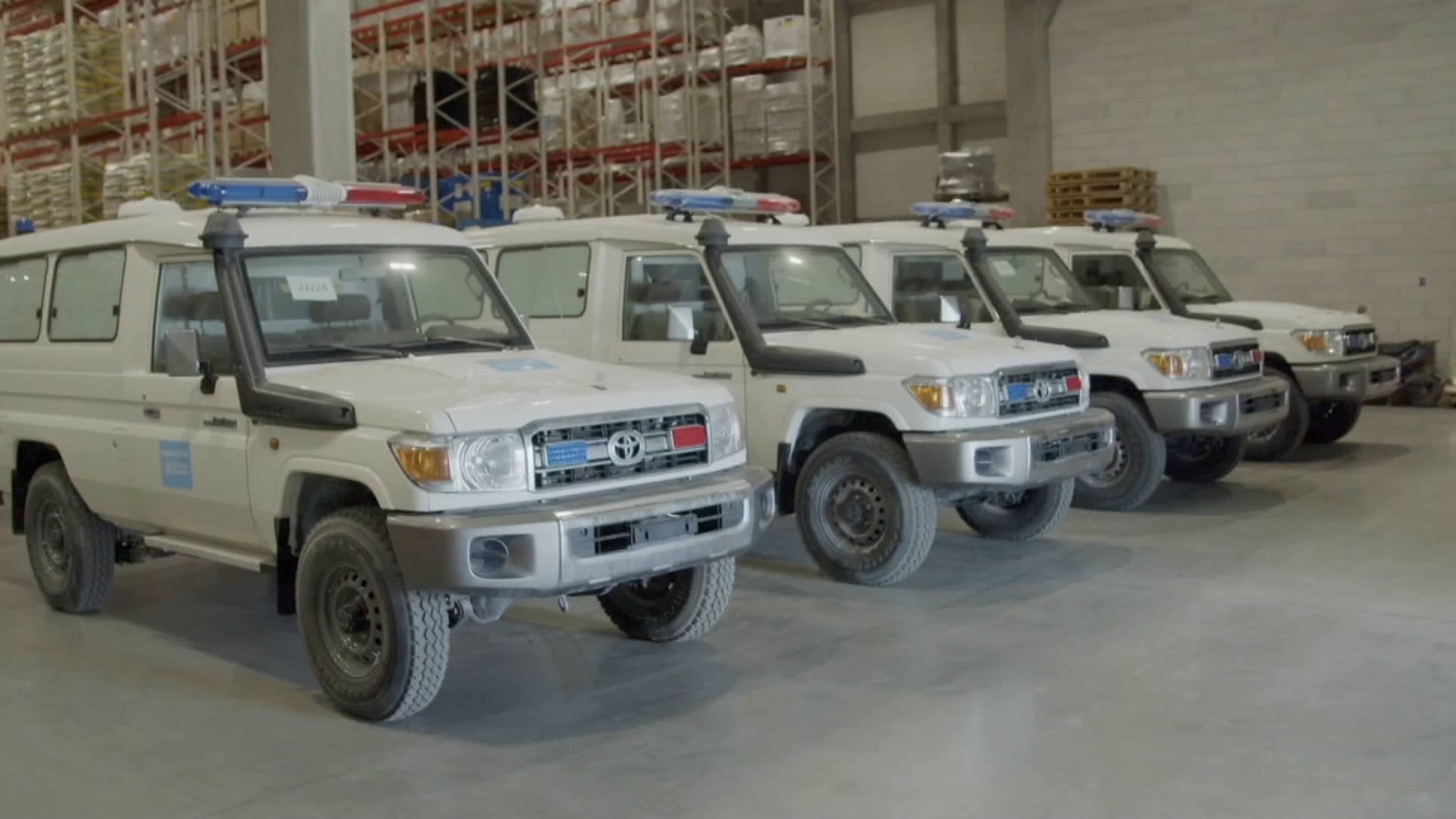
1. Pan right, donated ambulances
18 DECEMBER 2023, KHERSON OBLAST, UKRAINE
2. SOUNDBITE (English) Dr Jarno Habicht, WHO Representative in Ukraine:
“Today I am in Kherson Oblast with WHO team opening the centre. The centre, which is an outpost centre for emergency care doctors who will work here, bringing health services closer to hundreds of people who live here in Kherson Oblast. Across the whole oblast 80 percent of facilities have been damaged or destroyed, and we need to restore the services, the hope and security for people. These types of centres we are doing and building to ensure emergency care teams can work here. As well, working together with local authorities as well the Ministry of Health. This is what we do ensuring access to essential services here in Kherson. Thank you. Thank you. [In Ukrainian]”
16 DECEMBER 2023, KYIV, UKRAINE
3. Various shots, donated ambulances
4. SOUNDBITE (English) Dr Jarno Habicht, WHO Representative in Ukraine:
“WHO has delivered already 95 ambulances and together with these 20 additional ambulances, the number comes to 115.”
16 DECEMBER 2023, KYIV, UKRAINE
5. Various internal shots of donated ambulances
6. SOUNDBITE (English) Dr Jarno Habicht, WHO Representative in Ukraine:
"They have all the equipment, what is needed for the health care workers from the defibrillators to oxygen, but also other equipment. And this is very important that actually the health care workers who are doing tremendous work in the frontline can save the lives."
7. Various shots, donated ambulances
17 DECEMBER 2023, LYMAN, DONETSK
8. SOUNDBITE (English) Dr Jarno Habicht, WHO Representative in Ukraine:
“Today with WHO team, we are in Lyman. We are supporting Lyman Hospital and primary health care. The hospital that has been attacked. But the doctors and nurses are continuing to do their work. We have brought medicines, equipment for adults and for children. As we have 12,000 people living here, including 600 children. And we have supported also the laboratory to have basic equipment after the previous equipment was destroyed. We are here to support, we are here to restore the services, and I am really appreciative to the resilience of the doctors and nurses with whom we talk today to hear their stories while they are continuing to save the lives, and the World Health Organization is with them. Thank you. [In Ukrainian]”
16 DECEMBER 2023, KYIV, UKRAINE
9. Various shots, WHO team and partners inspecting ambulances
WHO has donated 20 ambulances to the Ministry of Health of Ukraine to enable the provision of emergency medical care to patients during the war. Designed as mobile intensive care units, the ambulances will be used to provide the necessary care for patients who need extra life-supporting activities during transportation to hospitals and between hospitals.
This is the latest such donation by WHO in nearly 2 years of full-scale war.
“With the devastating impact of war on Ukraine’s health system, these 20 ambulances will enable interhospital medical transportation across Ukraine, including the country’s eastern and southern regions, equipped to provide intensive and highly specialized care to seriously injured patients,” said Dr Gundo Weiler, Director of the Division of Country Support and Partnerships and acting Regional Emergency Director at the WHO Regional Office for Europe.
“Since the beginning of the war, WHO has supported Ukraine with the provision of essential medical supplies and equipment to ensure the continuity of care and meet the urgent health needs of the Ukrainian people. Together with health partners we stand united, and in 2024, we are committed to further addressing both humanitarian and recovery needs to maintain resilience of Ukraine’s health system in face of the challenges,” said Dr Jarno Habicht, WHO Representative in Ukraine.
The ambulances donated today are equipped with a range of crucial life-supporting devices, including defibrillator-monitors, lung ventilators, medical oxygen delivery equipment, infusion pumps, ECG machines, stretchers, trauma care equipment and other devices, allowing for the provision of life-saving care to critical patients during medical transportation.
"Ambulances are not just cars – they enable medics to save lives. In conditions of constant shelling, regular updating of the fleet of emergency medical vehicles is crucial. The Russian forces have already destroyed or damaged almost 500 ambulances. I am sincerely grateful to our international partners for their understanding and broad support. The 20 ambulances being provided to us by WHO today will soon support the work of doctors where they are currently most needed. They are equipped with everything that is necessary to provide medical assistance to patients in the most difficult conditions," said Viktor Liashko, Minister of Health of Ukraine.
Since full-scale war erupted on 24 February 2022, 95 ambulances have been donated to the Ministry of Health by WHO and its partners. More ambulances are set to be delivered in coming months.
The delivery was made possible with funding from the German government, the biggest donor to date towards WHO’s health response to the war in Ukraine.
“Germany has been standing with Ukraine since the very first days of the Russian invasion. This donation is part of the overall support from the Government of Germany to WHO emergency programmes in Ukraine and in the neighbouring countries that receive and host refugees, amounting to more than EUR 30 million this year. We thank the WHO team in Ukraine for their outstanding work,” said Dr Tim Prange, Deputy Ambassador of Germany to Ukraine.
Overall, WHO has delivered more than 4000 metric tonnes of life-saving medical supplies to Ukraine since the war began. Deliveries have included power generators, ambulances, oxygen supplies for medical facilities, supplies for trauma and emergency surgeries, and medicines to help treat noncommunicable diseases.