Media Home
 UN Web TV
 UN Audiovisual Library
 UN Photo
WEST BANK / HEALTH SERVICES
Download
There is no media available to download.
Share
STORY: WEST BANK / HEALTH SERVICES
TRT: 2.06
SOURCE: UNICEF
RESTRICTIONS: NONE
LANGUAGE: ENGLISH / ARABIC / NATS
DATELINE: 30 APRIL 2009, JBARA, WEST BANK, OCCUPIED PALESTINIAN TERRITORIES
1. Wide shot, women receiving health information
2. Med shot, women learning about breastfeeding
3. Med shot, mothers and children
4. Pan, group
5. Med shot, mother and child
6. SOUNDBITE (English) Kanar Qadi, UNICEF Field Officer:
“The work here is very important because without the help of UNICEF the Ministry of Health would not have been able to come in here. It is very difficult to access Jbara without any permits or co-ordination and UNICEF has been able to do that for the past two years with the health team and today if we didn’t work with the ministry of health it would have been very difficult to provide these services.”
7. Med shot, doctors giving health advice
8. Med shot, health worker
9. SOUNDBITE (Arabic) Na’ela Awad, Jbara Resident:
“I have welcomed all the health workers to my house because there’s nowhere else for them to meet in the village … we don’t have any municipal facilities such as a town hall.”
10. Med shot, mother waiting with child
11. Close up, child getting shot
12. Wide shot, doctors ministering to children
13. Close up, child getting finger pricked
14. SOUNDBITE (Arabic) Lamia Mustafa, Mother:
“This is beneficial for mothers. Most of them are not aware of breast or uterine cancer because they spend most of their time at home.”
15. Med shot, mother bringing child to temporary clinic
16. Med shot, mothers and children waiting in temporary clinic
17. Med shot, health workers
18. Med shot, woman picking up health pamphlets
19. Med shot, mothers and children
For the tiny community of Jbara in the West Bank even the most basic professional health care is a luxury.
These women are learning about the importance of breastfeeding. This is the first time Jbara has received a visit from health workers since the Israeli-constructed barrier shut the village off from the outside world in 2002.
Permits are required to enter and leave the Jbara. To get here means passing through military gates, often a difficult and time-consuming process.
SOUNDBITE (English) Kanar Qadi, UNICEF Field Officer:
“The work here is very important because without the help of UNICEF the Ministry of Health would not have been able to come in here. It is very difficult to access Jbara without any permits or co-ordination and UNICEF has been able to do that for the past two years with the health team and today if we didn’t work with the ministry of health it would have been very difficult to provide these services.”
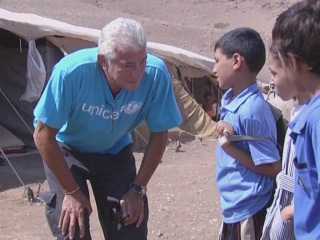
UNICEF and the Ministry of Health have brought doctors and vital information and their visit is warmly welcomed.
SOUNDBITE (Arabic) Na’ela Awad, Jbara Resident:
“I have welcomed all the health workers to my house because there’s nowhere else for them to meet in the village … we don’t have any municipal facilities such as a town hall.”
Doctors examine children and their mothers. Many children are suffering from years of medical neglect. They hope that simple preventative measures will help these villagers to avoid more serious health problems.
SOUNDBITE (Arabic) Lamia Mustafa, Mother:
“This is beneficial for mothers. Most of them are not aware of breast or uterine cancer because they spend most of their time at home.”
UNICEF is committed to getting the best possible care to marginalized communities in the West Bank. It’s aiming to boost the health of children by providing vaccines and nutritional supplements, as well as giving families vital information about basic health issues.