Media Home
 UN Web TV
 UN Audiovisual Library
 UN Photo
UN / RWANDA GENOCIDE ANNIVERSARY ADVANCER
Download
There is no media available to download.
Share
STORY: UN / RWANDA GENOCIDE ANNIVERSARY
TRT: 4:02
SOURCE: UNTV / IRIN / UNHCR / UNICTR / IRIN
RESTRICTIONS: NONE
LANGUAGE: ENGLISH / KINYARWANDA / NATS
DATELINE: 1 APRIL 2010, NEW YORK CITY / FILE
FILE - UNTV - OCTOBER 2007, KIGALI, RWANDA
1. Various shots, aerial view of Rwanda
2. Wide shot, Rwanda skyline
FILE - IRIN – JUNE 2005, GIKONGORO, RWANDA
3. Various shots, Murambi Technical school genocide memorial
UNTV - 1 APRIL 2010, NEW YORK CITY
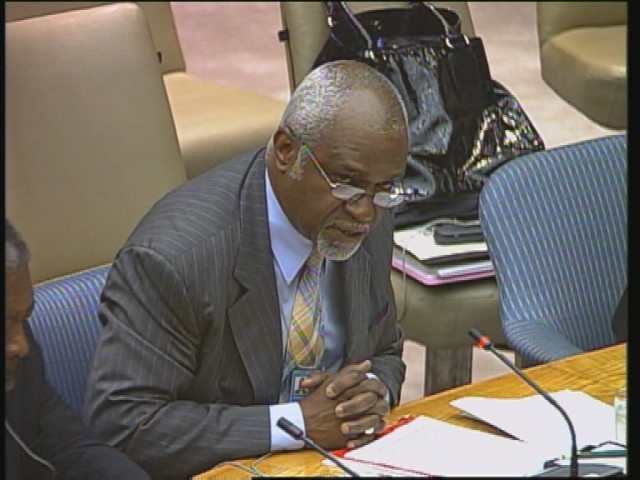
4. SOUNDBITE (English) Francis Deng, Special Advisor for Prevention of Genocide, United Nations:
“Among the places that I went to was a church which was one of the worst scenes of the atrocities of genocide. I landed from a helicopter some 100 yards from the church and as I entered the churchyard through the archway where bodies were piled so it was literally hard to step in without stepping on bodies.”
FILE - UNTV - DATE UNKNOWN, RWANDA
5. Pan left, doorway to skeletons in the room
FILE – UNTV - 1994, RWANDA
6. Various shots, Rwanda during genocide
FILE - UNHCR – MAY 2004, RWANDA
7. Various shots, pile of machetes
UNTV - 1 APRIL 2010, NEW YORK CITY
8. SOUNDBITE (English) Francis Deng, Special Advisor for Prevention of Genocide, United Nations:
“Although international presence was overwhelming I felt a sense of a paradox that there was so much global response after the genocide when the world had actually abandoned Rwanda at a crucial moment.”
FILE – UNTV - OCTOBER 2007, KIGALI, RWANDA
9. Med shot, United Nations tank
FILE – UNHCR – 2004, TANZANIA
10. Wide shot, displaced people fleeing to Tanzania
11. Close up, displaced Rwandans
12. Various shots, Rwandans fleeing in rain
13. Med shot, refugees sheltering
FILE - UNICTR - 16 NOVEMBER 2009, ARUSHA, TANZANIA
14. Med shot, International Criminal Tribunal for Rwanda (ICTR) headquarters
15. Various shots, Judges entering inside the courtroom
16. Close up, Chief Prosecutor of ICTR Hassan Bubacar Jallow
UNTV - 1 APRIL 2010, NEW YORK CITY
17. SOUNDBITE (English) Francis Deng, Special Advisor for Prevention of Genocide, United Nations:
“I kept wondering how many people in the end would be found to have been responsible for genocide of close to a million people. And I couldn’t but think that legally to prove beyond doubt that people had actually committed these acts with the intent to destroy in whole or in part as the definition of genocide goes a whole people. In all likelihood only a few will be found guilty and that could raise a question of people feeling that justice had not been done and the risk of taking justice into their hands.”
FILE – IRIN – JUNE 2005, GIKONGORO, RWANDA
18. Various shots, people arriving to the Gacaca court
19. Various, Gacaca court members arriving
20. SOUNDBITE (Kinyarwanda) (unidentified name) President, Gacaca Court:
"To answer to the Gacaca convocation is an obligation for every Rwandans. Those who refuse to testify on what he saw and heard would face judiciary pursuits and risk between three and six months imprisonment."
21. Med shot, people listening to the Gacaca Court
UNTV - 1 APRIL 2010, NEW YORK CITY
22. SOUNDBITE (English) Francis Deng, Special Advisor for Prevention of Genocide, United Nations:
“I have been back to Rwanda and the difference that the government has made during this period was absolutely striking. You saw a country that seems to be back to itself, a country that seems to be developing quite remarkably.”
FILE – UNICTR - MARCH 2006, BUTARE, RWANDA
23. Various shots, Butare town
24. Various shots, genocide memorial at Butare University
In advance of the 16th commemoration of the genocide in Rwanda, United Nations (UN) Special Adviser on Genocide Prevention Francis Deng talked about his visit to the country shortly following the genocide during which close to a million people were killed in less than 100 days.
SOUNDBITE (English) Francis Deng, Special Advisor for Prevention of Genocide, United Nations:
“Among the places that I went to was a church which was one of the worst scenes of the atrocities of genocide. I landed from a helicopter some 100 yards from the church and as I entered the churchyard through the archway where bodies were piled so it was literally hard to step in without stepping on bodies.”
Deng, who was the UN Special Representative for Internally Displaced People at that time, visited the country just three months after the genocide in 1994.
That year, Rwanda’s ethnic Hutu militia, armed with machetes, clubs and spears, took over the streets of the country slaughtering minority Tutsis. Many Hutus were faced with a choice – either join the mobs or protect their fellow citizens, though it meant putting their own lives at risk.
During the genocide, the UN Security Council withdraw most of the 2,500 UN peacekeepers in Rwanda. In 2000, the Council accepted responsibility for failing to prevent the 1994 genocide.
SOUNDBITE (English) Francis Deng, Special Advisor for Prevention of Genocide, United Nations:
“Although international presence was overwhelming I felt a sense of a paradox that there was so much global response after the genocide when the world had actually abandoned Rwanda at a crucial moment.”
Soon after the genocide, the UN Refugee Agency reported that more than a million Rwandans fled to neighboring countries such as the Democratic Republic of Congo (DRC) and Tanzania. Last year, an estimated 50,000 Rwandan refugees remained in exile in the DRC.
In order to prosecute the perpetrators of the genocide, the UN established the International Criminal Tribunal for Rwanda (ICTR) a year following the genocide. ICTR, which is based in Tanzania’s capital Arusha, recently delivered the first-ever verdicts in relation to genocide by an international court.
17. SOUNDBITE (English) Francis Deng, Special Advisor for Prevention of Genocide, United Nations:
“I kept wondering how many people in the end would be found to have been responsible for genocide of close to a million people. And I couldn’t but think that legally to prove beyond doubt that people had actually committed these acts with the intent to destroy in whole or in part as the definition of genocide goes a whole people. In all likelihood only a few will be found guilty and that could raise a question of people feeling that justice had not been done and the risk of taking justice into their hands.”
The Rwandan Government also established the Gacaca court, a nationwide people's judicial system. In 2005, there were 12,103 Gacaca courts in all of Rwanda processing an estimated 130,000 suspects awaiting trial.
SOUNDBITE (Kinyarwanda) (unidentified name) President, Gacaca Court:
"To answer to the Gacaca convocation is an obligation for every Rwandans. Those who refuse to testify on what he saw and heard will face judiciary proceedings and risk between three and six months imprisonment."
According to official estimates, the number of people suspected of having participated in the genocide could exceed 700,000. The most important suspects, those accused of orchestration and genocide, continue to go before the ICTR.
In recent years, Deng said that the Government has not only made progress in helping to heal the wounds of Rwandans and promote national reconciliation; it has also developed economically.
SOUNDBITE (English) Francis Deng, Special Advisor for Prevention of Genocide, United Nations:
“I have been back to Rwanda and the difference that the government has made during this period was absolutely striking. You saw a country that seems to be back to itself, a country that seems to be developing quite remarkably.”
UN Development Programme reported that Rwanda has since 1994 recorded impressive gains towards the Millennium Development Goals with 97 percent enrollment of primary school enrolment for all school-going age children.
Policies and laws that guarantee equal opportunities for men and women, according to the International Federation of Red Cross and Red Crescent Societies, have resulted in Rwanda holding a world record of women parliamentarians - 56.3 percent, just ahead of Sweden at 46.4 percent.
Official records show that this year the economy should grow by 7 to 8 percent, up from 5.5 percent in 2009.