Media Home
 UN Web TV
 UN Audiovisual Library
 UN Photo
GENEVA / JAPAN HEALTH
Download
There is no media available to download.
Share
STORY: GENEVA / JAPAN HEALTH
SOURCE: WHO
TRT: 1.44
RESTRICTIONS: NONE
LANGUAGE: ENGLISH/ NATS
DATELINE: 15 MARCH 2011, GENEVA, SWITZERLAND/ FILE
FILE – RECENT, GENEVA, SWITZERLAND
1.Zoom in, WHO Headquarters
15 MARCH 2011, GENEVA, SWITZERLAND
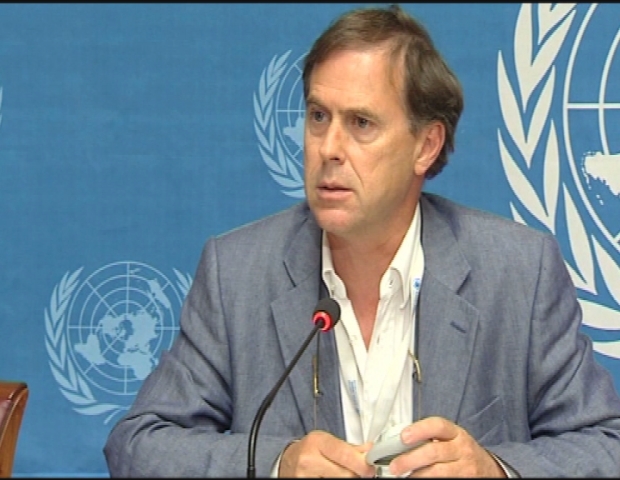
2.SOUNDBITE (English) Maria Neira, Director, Public Health and Environment, World Health Organization (WHO):
“The situation as you know is evolving very, very quickly and WHO is, we are following with great concern the situation over there and what that situation can represent in terms of affecting human health. The measures that have been taken until now according with existing data and according with the present current situation are those that the public health, the international public health community will endorse and recommend, which means that evacuating people from the most contaminated area, as a precautionary measure and as preventive measure. And then proposing that people living around a radius of 30km they should stay indoors. This is order to avoid exposure to breathing particles, radioactive particles, in the air. In addition to that, we know that the Japanese authorities, are propositioning potassium iodide in case this needs to be distributed to the population and I take advantage of that to say that potassium iodide has to be consumed only if recommend by the authorities.“
FILE – RECENT, GENEVA, SWITZERLAND
3.Zoom in, WHO emblem
15 MARCH 2011, GENEVA, SWITZERLAND
4.SOUNDBITE (English) Maria Neira, Director, Public Health and Environment, World Health Organization (WHO):
“Additional measures might need to be taken depending on how everything will evolve. We are hoping for the best but we need to be prepared as well.”
FILE – RECENT, GENEVA, SWITZERLAND
5.Zoom in, WHO Headquarters
15 MARCH 2011, GENEVA, SWITZERLAND
6.SOUNDBITE (English) Maria Neira, Director, Public Health and Environment, World Health Organization (WHO):
“WHO is working with our partners and we have a big network of collaborating centres with experts from all around the world. The good news here is that there is a lot of experience of preparedness plans and manuals describing the measures that needs to be taken.”
FILE – RECENT, GENEVA, SWITZERLAND
7.Zoom in, WHO flag
According to the World Health Organization (WHO) actions proposed by the Government of Japan to deal with the current and rapidly evolving nuclear situation in the country are in line with the existing recommendations based on public health expertise.
The Government is asking people living within 20 km of the Fukushima Daiichi nuclear power plant to evacuate and those between 20 km and 30 km are asked to stay indoors in unventilated rooms. People living farther away are at a lower risk than those who live nearby.
SOUNDBITE (English) Maria Neira, Director, Public Health and Environment, World Health Organization (WHO):
“The situation as you know is evolving very, very quickly and WHO is, we are following with great concern the situation over there and what that situation can represent in terms of affecting human health. The measures that have been taken until now according with existing data and according with the present current situation are those that the public health, the international public health community will endorse and recommend, which means that evacuating people from the most contaminated area, as a precautionary measure and as preventive measure. And then proposing that people living around a radius of 30km they should stay indoors. This is order to avoid exposure to breathing particles, radioactive particles, in the air. In addition to that, we know that the Japanese authorities, are propositioning potassium iodide in case this needs to be distributed to the population and I take advantage of that to say that potassium iodide has to be consumed only if recommend by the authorities.“
WHO radiological experts have been working closely with Japanese authorities and the International Atomic Energy Agency (IAEA) to monitor the evolving situation. WHO experts share Japan's concerns about the situation around the affected facility. This assessment can change if there are further incidents at these plants and WHO is following the situation closely.
SOUNDBITE (English) Maria Neira, Director, Public Health and Environment, World Health Organization (WHO):
“Additional measures might need to be taken depending on how everything will evolve. We are hoping for the best but we need to be prepared as well.”
However, radiation-related health consequences will depend on exposure. Exposure in turn is dependant on the amount of radiation released from the reactor, weather conditions such as wind and rain at the time of the explosion, the distance someone is from the plant, and the amount of time someone is in irradiated areas.
SOUNDBITE (English) Maria Neira, Director, Public Health and Environment, World Health Organization (WHO):
“WHO is working with our partners and we have a big network of collaborating centres with experts from all around the world. The good news here is that there is a lot of experience of preparedness plans and manuals describing the measures that needs to be taken.”
The most recent advice followed an explosion early this morning at the number two reactor at the Fukushima Daiichi nuclear facility. The blast caused a radiation leak that a government official described as serious enough to have "an impact on human health" to people near the plant.
Shortly before the incident at the number two reactor, there was an explosion followed by a fire at unit 4, which is used to store used nuclear material. The fire was put out a few hours later.