Media Home
 UN Web TV
 UN Audiovisual Library
 UN Photo
IMF / LAGARDE
Download
There is no media available to download.
Share
STORY: IMF / LAGARDE
SOURCE: IMF
TRT 2:17
RESTRICTIONS: NONE
LANGUAGES: ENGLISH / NATS
DATELINE: 15 JANUARY 2013, WASHINGTON D.C.
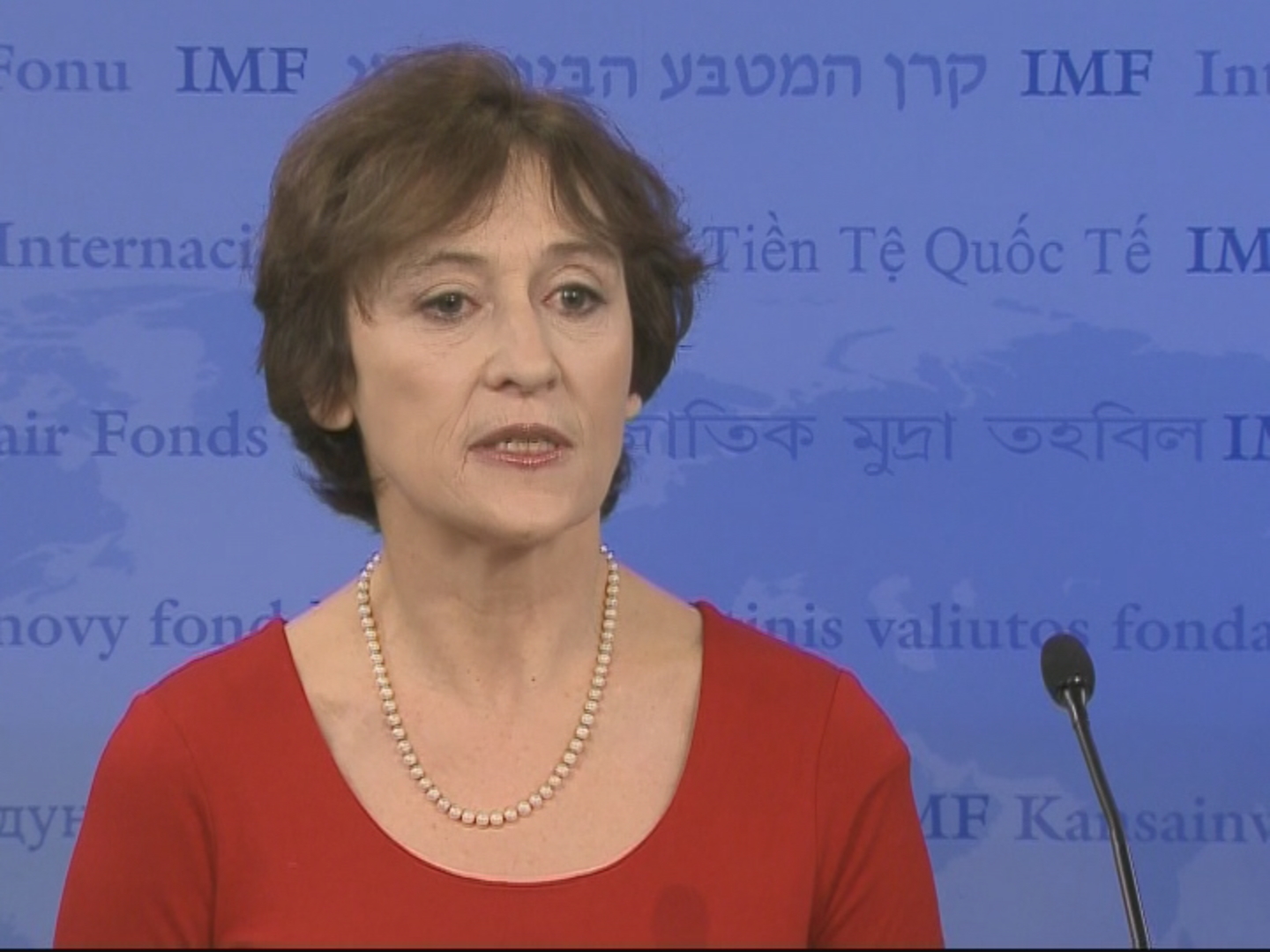
1. Med shot, IMF Managing Director Christine Lagarde taking her seat
2. SOUNDBITE (English) Christine Lagarde, IMF Managing Director:
“We stopped the collapse. We should avoid the relapse. It is not time to relax.”
3. Cutaway, reporters
4. SOUNDBITE (English) Christine Lagarde, IMF Managing Director:
“All sides should pull together in the national interest, avoiding further avoidable policy mistakes, that is failing to agree on increasing the debt ceiling, on time and prior to that preferably. And reaching agreement on medium-term debt reduction.”
5. Cutaway, reporters
6. SOUNDBITE (English) Christine Lagarde, IMF Managing Director:
“We have made a range of proposals; they are just proposals for the moment, clearly. The Portuguese authorities have to decide what is most appropriate in the context of Portugal and if they have other options that are best accomplished in order to both accomplish the fiscal consolidation and preserve the chemistry of Portuguese society, that is perfectly legitimate and fine.”
7. Cutaway, reporters
8. SOUNDBITE (English) Christine Lagarde, IMF Managing Director:
“Research was done and research is constantly done. The IMF does not operate on the basis of principles that are set in stone, and forever. I think the pride of this institution is to constantly question, challenge, revisit, reexamine, test, the findings and the assumptions, in order to be as up to date as possible.”
9. Cutaway, reporters
10. SOUNDBITE (English) Christine Lagarde, IMF Managing Director:
“We believe that an economic set of reforms and focus on growth must be applied to those economies that have gone through political transformation, and that there has to be an economic response to the social and peoples restoration. That is what we're trying to help.”
11. Various shots, Christine Lagarde leaving the press conference room
International Monetary Fund Managing Director Christine Lagarde said Thursday (17 January) that although the policymakers stopped a collapse of the global economy in 2012, policymakers need avoid a relapse of uncertainty, and cannot afford to relax in the New Year.
She named high levels of unemployment and still-pending reform of financial sector regulation as warning signs that global policymakers need to press on.
“We stopped the collapse. We should avoid the relapse. It is not time to relax,” Lagarde told a group of reporters in the Washington, DC headquarters of the IMF.
Lagarde said that one of the main challenges facing the global economy now was the wait for the U.S. Congress to raise the debt ceiling, or the limit on the federal government’s ability to borrow, and agree on a plan to cut debt and deficit levels to sustainable levels.
“All sides should pull together in the national interest, avoiding further avoidable policy mistakes, that is failing to agree on increasing the debt ceiling, on time and prior to that preferably. And reaching agreement on medium-term debt reduction,” Lagarde said.
Turning to Europe, the IMF agreed to disburse another 838 million euros to Portugal on January 16. Lagarde said that the IMF has presented options to the Portuguese government about how to reduce debt levels while create openings for the economy to grow. She said the government will decide how to respond based on its economy’s needs.
“We have made a range of proposals, they are just proposals for the moment, clearly. The Portuguese authorities have to decide what is most appropriate in the context of Portugal and if they have other options that are best accomplished in order to both accomplish the fiscal consolidation and preserve the chemistry of Portuguese society, that is perfectly legitimate and fine,” Lagarde said.
Looking at the Middle East, Lagarde said that the IMF is keen to support Arab countries in transition, with programs already in place in Yemen, Morocco, and Jordan.
“We believe that an economic set of reforms and focus on growth must be applied to those economies that have gone through political transformation, and that there has to be an economic response to the social and peoples restoration. That is what we're trying to help,” Lagarde said.