Media Home
 UN Web TV
 UN Audiovisual Library
 UN Photo
UN / GUINEA-BISSAU
Download
There is no media available to download.
Share
STORY: UN / GUINEA-BISSAU
TRT: 1.50
SOURCE: UNTV
RESTRICTIONS: NONE
LANGUAGE: ENGLISH / NATS
DATELINE: 5 FEBRUARY 2013, NEW YORK CITY / FILE
FILE – 2011, NEW YORK CITY
1. Wide shot, exterior United Nations Headquarters
5 FEBRUARY 2013, NEW YORK CITY
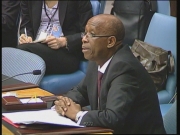
2. Wide shot, Security Council
3. Cutaway, delegates
4. SOUNDBITE (English) Taye-Brook Zerihoun, Assistant Secretary-General for Political Affairs, United Nations:
“Notwithstanding the positive efforts to ensure inclusiveness in the transition process, impunity remains a major problem. There is a general atmosphere of fear within the population arising from the recent cases of beatings, torture and intimidation that continue to restrict freedom of assembly and information.”
5. Cutaway, delegates
6. SOUNDBITE (English) Taye-Brook Zerihoun, Assistant Secretary-General for Political Affairs, United Nations:
“Visits by UNIOGBIS to prisons and detentions centres have confirmed inadequate detention conditions and lack of access of detainees to medical care, food, potable water. The mission has advised the Ministry of Justice of the situation.”
7. Cutaway, delegates
8. SOUNDBITE (English) Taye-Brook Zerihoun, Assistant Secretary-General for Political Affairs, United Nations:
“They hamper the effective functioning of State institutions and highlight the urgent need to radically change the way in which politics is conducted in the country, as well as the imperative of fundamental reform of the defence, security and justice sectors.”
9. Cutaway, delegates
10. SOUNDBITE (English) Taye-Brook Zerihoun, Assistant Secretary-General for Political Affairs, United Nations:
“While the restoration of constitutional order in Guinea-Bissau through credible elections remains the key priority for the country, it is also necessary for the international community to support efforts aimed at combating impunity during the transition period and in the medium to longer term if stability is to be sustainable.”
11. Cutaway, delegates
12. Wide shot, Security Council
A senior United Nations (UN) official told the Security Council today (5 February) that in spite of positive efforts to ensure inclusiveness in the Guinea-Bissau transition process, still “impunity remains a major problem”.
Assistant Secretary-General for Political Affairs, Taye-Brook Zerihoun, said the signing of a political transition pact and political agreement by the junta and the different political parties in the country in January would facilitate consensus on a transition roadmap that would include among other things the timeline for the presidential and legislative elections.
But he pointed out a general atmosphere of fear within Guinea-Bissau’s population “arising from the recent cases of beatings, torture and intimidation”, which he said continued to restrict freedom of assembly and information.
Zerihoun said visits by officials from the United Nations Integrated Peace-Building Office in Guinea-Bissau (UNIOGBIS) to prisons and detentions centres had confirmed “inadequate detention conditions and lack of access of detainees to medical care, food, potable water”. He said that the mission had advised the Ministry of Justice of that situation.
He also denounced that the continued lack of civilian control and oversight over the defence and security forces plus the continued attempts by some politicians to manipulate the military for sectarian benefit. He said this hampered the effective functioning of State institutions and highlighted “the urgent need to radically change the way in which politics is conducted in the country, as well as the imperative of fundamental reform of the defence, security and justice sectors”.
Zerihoun noted that while the restoration of constitutional order in the country through credible elections remained a key priority, it was also necessary for the international community to support efforts aiming at combating impunity during the transition period, “and in the medium to longer term if stability is to be sustainable”.
Guinea-Bissau has a tumultuous history of coups, misrule and political instability since it gained independence from Portugal in 1974. Most recently, rogue soldiers seized power in a military take-over on 12 April 2012 – just days ahead of the presidential run-off election – prompting calls from the international community for the return to civilian rule and the restoration of constitutional order. Recent incidents include an attack on a military base in October, which reportedly resulted in numerous deaths.
UNIOGBIS was established by the Security Council in 2009 and tasked with promoting stability in the West African nation, which has been beset by coups and political instability since it became independent in the early 1970s.
In the next days former Timorese President and Nobel Peace Prize laureate Jose Ramos-Horta will succeed Joseph Mutaboba of Rwanda as the Secretary-General’s Special Representative and Head of UNIOGBIS.